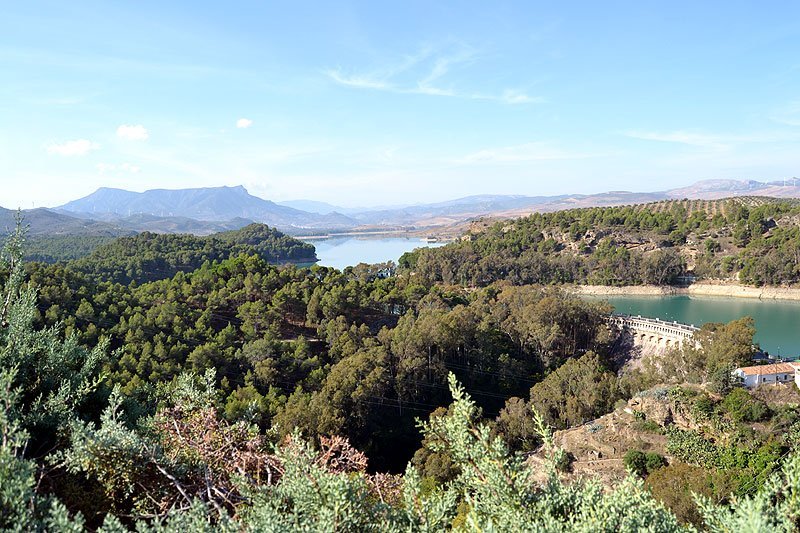
El Chorro Gorge and the Caminito del Rey, an impressive gorge formed by river erosion through the limestone mountain. In Spanish it is called El Desfiladero de los Gaitanes and is a well known natural attraction as the towering cliffs are around 200m high while only 10m wide at some points. The river below has been dammed, the Embalse Gaitanejo is one of the smaller reservoirs of five in this area. Alongside this reservoir sits the small village of El Chorro, built in the shadow of the mountain around the railway station.
The area is probably most famous for ‘El Caminito del Rey’ or the ‘King’s Way’ which is a built, narrow path that clings to the cliffs 100m above the river Once hanging in ruins, the walkway has been repaired and is now listied among the top 10 tourist attractions of Andalucia.
Find a hotel in the El Chorro Gorge and the Caminito del Rey
Some Background and History
This path was created between 1901 and 1905 as the service access for a canal. Its name came about as King Alfonso XIII walked the path in 1921 to view the dammed river at its inauguration. The walkway, created from a metal structure attached to the cliff supporting a concrete narrow path, had been gradually disintegrating to a point where large stretches were missing. It was closed to the public for years but was still popular forclimbers and adrenalin junkies.
Click here to find out more about the Caminito del Rey
The Desfiladero de Gaitanes is slightly separated from the Desfiladero de Gaitanejo by the more open area named La Hoya. As there are three rivers that feed into these gorges El Chorro would have been a frightening place to witness times of heavy rain and flooding as there would have been a tremendous pressure of water crashing through. These dams have not only calmed this natural phenomenon but also supply electricity, drinking and irrigation water to the more heavily populated areas to the south.
The railway line from Cordoba to Malaga which is still in use weaves its way through this gorge in an impressive feat of engineering, via 12 tunnels and 6 bridges. (Closed to walkers for obvious safety reasons).
These amazing, vertical cliffs are home to Griffon Vultures, Golden and Bonelli’s eagles, Peregrine falcon as well as Alpine swifts, Crag martins and Blue rock thrush.

The drive from the gorge northwards towards Ardales village and the Guadalhorce lakes takes you through contrasting, rounded sandstone terrain with Aleppo pine forest and Mediterranean scrub. A small diversion takes you up to another small reservoir, sign posted for Bobastro. This high reservoir is filled at night when electricity consumption is low, then released back down huge tubes to turbines so creating power at peak times.
Half way up the mountain is the unique Bobastro church carved out of a single rock and village that now lays derelict and abandoned. It was the fortified base of a major revolt by “Umar ibn Hafsun” against the Moors Caliph based in Cordoba. For the first and last time in history, Hafsun managed to assemble and unite an army of Moslems and Christians under his command. In the later part of his life Umar ibn Hafsun converted to Christianity and commissioned the amazing church.
Paying respect to followers of both faiths, Bobastro church was deliberately built facing Mecca, enabling all soldiers of his army to pray in the same place. After his death, his 30-year rebellion was finally put down by the Caliph of Cordoba and his body was dug up and hanged for his crimes against the Caliphate and conversion from Islam.
Read more about Bobastro and Umar Ibm Hafsun here.
Returning to the main road and continuing northwards leads you to the first of the three large reservoirs ‘Embalse del Conde del Guadalhorce’ which is very popular for beach side picnics, fishing and water sports.
Heading next towards the dams of the rivers Guadalhorce, Teba, and Turón takes you through more pine woods where the blueness of the water adds to the lushness of the setting.
You will pass by several bars and restaurants (and the car parks for the Caminito del Rey) close to the lakes before reaching the first dam.
Wildlife in the Area
The scrub birds include Sardinian warbler and Rock bunting while the woodland species include Crossbills, Short-toed tree creeper, Coal and Crested tit, Goldfinches, Greenfinches and Nuthatches.
The Mediterranean scrub plants include Lentisc (Pistacia lentiscus), Grey-leaved rock rose (Cistus albidus), Prickly juniper (Juniperus oxycedrus), Anthyllis cytisoides, the silver –leaved bugloss Echium albicans, culinary Rosemary (Rosmarinus officinalis), Dwarf fan palm (Chamaerops humilis) a selection of Thymes and the unusual climbing Andalusian birthwort (Aristolochia baetica).
Although, strictly speaking, the Natural Reserve only includes the Gaitanejo River Dam, we would be unable to understand the dynamics and complexity of the open area without the other river dams that surround it which are the Conde de Guadalhorce, Guadalteba, Guadalhorce y Tajo de La Encantada.) these make up, as a whole, one of the most important hydraulic complexes in Andalucia.
El Caminito del Rey & El Chorro Gorge: Visitor FAQs, History & Travel Tips
El Desfiladero de los Gaitanes, often called El Chorro Gorge, is renowned for its dramatic cliffs — over 200 metres high yet just 10 metres wide in places. The area is also home to the Caminito del Rey, a suspended walkway that snakes along the rock face 100 metres above the river. It’s one of Andalusia’s most striking natural and historical landmarks.
Originally built between 1901 and 1905, the Caminito del Rey served as an access path for workers maintaining a canal system. Its name came after King Alfonso XIII walked it during the 1921 dam inauguration. After decades of neglect, it was fully restored and reopened as a safe hiking attraction, now listed among the top ten sites to visit in Andalusia.
Not anymore. The original walkway had fallen into ruin and was unsafe for decades, but it has since been completely rebuilt with reinforced platforms and safety railings. Visitors now follow a guided, one-way route with limited daily entries. However, the experience still offers a thrilling sense of adventure, as the path clings to the cliffs above the gorge.
The gorge is a haven for birdwatchers. Griffon vultures soar above, joined by golden eagles, peregrine falcons, and alpine swifts. Woodland areas are filled with crossbills, nuthatches, and warblers. Botanists will also enjoy spotting Mediterranean flora such as rosemary, lentisc, and the dwarf fan palm along the trails and reservoir banks.
Just a short drive away lies the Bobastro archaeological site, where Umar ibn Hafsun’s rock-carved church tells a fascinating story of rebellion and faith. The nearby Guadalhorce Lakes offer swimming, kayaking, and picnic areas surrounded by pine forest. Each spot reveals a different side of this wild Andalusian landscape.
The main access points are from Ardales or El Chorro village, both reachable by car or train from Málaga. The Parador de Antequera and small guesthouses around El Chorro provide comfortable stays close to the trail. It’s best to book Caminito tickets in advance, especially during spring and autumn when demand peaks.

Clive Muir – Wildside Holidays – Walking, wildlife and culture holidays in Spain
I’ve been living in western Andalucía for more than 20 years and spend much of my time researching and running English-language travel websites about Spain. My work covers destinations including Cádiz, Ronda, Grazalema and the Caminito del Rey, as well as Wildside Holidays, which focuses on walking, wildlife and nature travel in Spain.
Through Wildside Holidays, I share practical information about Spain’s natural parks, mountains, wildlife and walking destinations, drawing on many years of living and travelling in the country. The aim is to help visitors discover Spain’s natural landscapes responsibly and plan rewarding walking and wildlife experiences.