- Capital: Pamplona.
- Area: 10,391 km²

Walking and wildlife in Navarra
Navarra is one of Spain’s most varied regions for walking and wildlife holidays.
Within a relatively small area, the landscape changes dramatically from the Atlantic-influenced forests of the Pyrenees in the north to the fertile Ebro Valley and the remarkable semi-desert of Bardenas Reales in the south.
Although neighbouring the Basque Country, Navarra has its own distinct identity. Euskera is still spoken in parts of the north, reflecting the region’s long connection with Basque culture, while its history as an independent medieval kingdom has left castles, monasteries and ancient routes scattered across the landscape.
From the Pyrenees to the Camino de Santiago
The Roncesvalles Pass has connected France and Spain for centuries. Romans, shepherds and traders crossed here long before it became famous as the traditional starting point in Spain for many pilgrims walking the Camino de Santiago towards Galicia.
The Pyrenees dominate northern Navarra, where Mesa de los Tres Reyes rises to 2,444 metres on the border with Aragón and France. As the mountains give way to the Ebro Valley, the climate becomes noticeably drier, creating an extraordinary contrast between lush beech forests, limestone gorges, wetlands and desert-like badlands within the same region.
Hotels and accommodation in Navarra
Navarra has accommodation to match every style of trip, whether you’re planning a city break in Pamplona, a walking holiday in the Pyrenees, or a peaceful stay near the Irati Forest or Bardenas Reales.
Explore hotels in Navarra over at Booking.com
You’ll find everything from boutique hotels and historic inns to rural guesthouses, mountain lodges and Camino-friendly accommodation. Staying close to the landscapes you want to explore makes it much easier to experience Navarra’s wildlife, walking routes and quieter corners at your own pace.
Tours in Navarra from Get Your Guide
Navarra combines medieval history, mountain landscapes, world-class wine and the famous Camino de Santiago. Whether you’re exploring Pamplona, visiting Olite’s royal palace or discovering nearby wine country, organised tours can be an easy way to experience some of the region’s highlights.
Natural parks in Navarra
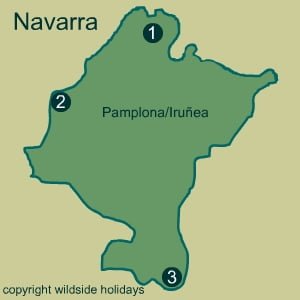
Navarra’s protected landscapes are among the most diverse in Spain. Within a relatively short drive you can walk through Atlantic beech forests, climb limestone plateaus, watch vultures soaring above deep gorges, or stand among the extraordinary badlands of Bardenas Reales.
The region’s wetlands, forests and mountain habitats support an impressive variety of wildlife, including griffon vultures, eagles, Purple Herons, Great Bitterns and Night Herons, making Navarra one of northern Spain’s finest destinations for walking and nature travel.
1. The Señorío de Bértiz Natural Park protects one of Navarra’s finest Atlantic forests along the Bidasoa River, around 49 kilometres north of Pamplona. Ancient woodland, riverside trails and carefully preserved parkland make it an excellent introduction to the greener side of northern Navarra.
Access is via Oronoz in the Baztan Valley or Oieregi in the Bertizarana Valley, and the network of walking routes makes it particularly rewarding for visitors who enjoy quieter woodland landscapes.
2. The Urbasa-Andía Natural Park is a landscape of limestone plateaus, beech forests and dramatic viewpoints, with sixteen peaks rising above 1,000 metres. Yews, junipers and pines grow alongside extensive beech woodland, creating one of Navarra’s classic mountain walking destinations.
The park’s mix of karst scenery, forests and open uplands supports a rich variety of wildlife and makes it one of the region’s best areas for longer walks.
3. The Bardenas Reales Natural Park and Biosphere Reserve is one of Spain’s most extraordinary landscapes. Wind and water have sculpted clay, chalk and sandstone into towering rock formations, deep gullies, flat-topped mesas and the distinctive isolated hills known as cabezos.
Despite its desert-like appearance, Bardenas Reales supports specialised wildlife adapted to this harsh environment, and its striking scenery has made it one of Navarra’s most photographed landscapes. Whether you’re walking, cycling or simply exploring its viewpoints, it offers a completely different side of northern Spain.
Looking for guided or self guided walking in Navarra?

Walking North Spain are located in San Sebastian in the heart of a fantastic area for holidays and mountain travel, trips and routes are arranged in most of northern Spain (Basque Country, Navarra, Western Pyrenees, La Rioja, Picos de Europa…), as well as in the French Basque Country and the French Pyrenees. https://wildsideholidays.co.uk/walking-north-spain/
The Irati Forest: one of Europe’s greatest beech forests
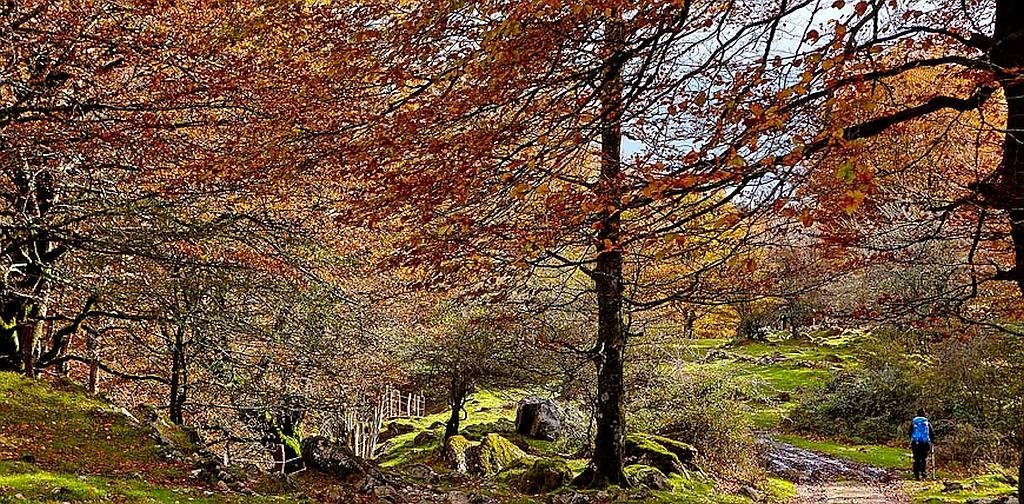
The Irati Forest, in the western Pyrenees, is one of Navarra’s greatest natural treasures. Covering around 17,300 hectares, it is one of Europe’s largest and best-preserved beech and fir forests, stretching across the valleys beneath Mount Okabe and Pic d’Orhy.
In autumn, the forest becomes one of northern Spain’s most spectacular walking destinations, while throughout the year its network of trails, rivers and mountain scenery makes it a favourite for wildlife watching, photography and peaceful woodland walks.
Other protected areas in Navarra
Beyond its three flagship natural parks, Navarra protects an impressive network of nature reserves, integral reserves, wetlands, river gorges and ancient forests. Many of these are little-known places that reward visitors looking for quieter landscapes away from the main tourist routes.
The list below provides a useful starting point for exploring these protected areas, and many will eventually become dedicated guides as Wildside Holidays expands its Navarra coverage.
- Aztaparreta Reserva integral
- Lizardoia Reserva integral
- Ukerdi Reserva integral
- Labiaga Reserva natural
- Peñas de Itxusi Reserva natural
- San Juan Xar Reserva natural
- Irubetakaskoa Reserva natural
- Cueva Basajaun Etxea Lanz Reserva natural
- Mendilaz Reserva natural
- Putxerri Reserva natural
- Tristuibartea Reserva natural
- Foz de Iñarbe Reserva natural
- Poche de Chinchurrenea Reserva natural
- Foz de Gaztelu Reserva natural
- Larra Reserva natural
- Barranco de Lasia Reserva natural
- Nacedero del río Urederra Reserva natural
- Barranco de Basaura Reserva natural
- Foz de Arbayún Reserva natural
- Foz de Benasa Reserva natural
- Foz de Burgui Reserva natural
- Peñalabeja Reserva natural
- Embalse de Salobre o de Las Cañas Reserva natural
- Monte de Olleta Reserva natural
- Monte del Conde Reserva natural
- Laguna del Juncal Reserva natural
- Acantilados de la Piedra y San Adrián Reserva natural
- Foz de Lumbier Reserva natural
- Caparreta Reserva natural
- Laguna de Pitillas Reserva natural
- Sotos del Arquillo y Barbaraces Reserva natural
- Sotos de la Lobera y Sotillo Reserva natural
- Sotos Gil y Ramal Hondo Reserva natural
- Vedado de Eguaras Reserva natural
- Soto del Ramalete Reserva natural
- Soto de la Remota Reserva natural
- Balsa de Agua Salada Reserva natural
- Balsa del Pulguer Reserva natural
- Rincón del Bu Reserva natural
- Caídas de la Negra Reserva natural
- Soto Quebrado, el Ramillo y la Mejana Reserva natural
Monumentos naturales in Navarra
Natural monuments are elements of singular landscape, geological and / or historical value – from a hundred-year-old tree to a forest or a cave – whose conservation advises a special type of protection.
Navarra protects an extraordinary collection of natural monuments, many of which are ancient trees that have become part of the region’s natural and cultural heritage. From centuries-old oaks and beeches to giant sequoias and yews, these living landmarks are protected because of their age, size or historical importance.
Some can be visited in village centres, while others require a short walk through forests and mountain landscapes. Local visitor centres are the best place to check current access conditions before setting out.
For visitors interested in exploring more of these remarkable trees, Navarra has also produced a detailed Spanish-language guide covering locations and descriptions across the region.
https://issuu.com/rutasnavarra/docs/amnavarra
1.Encina de Eraul
- Quercus ilex L. subsp. ilex x Quercus ilex subsp. ballota (Desf.) Samp.
- Town, village: Eraul
2. Encino de las Tres Patas
- Quercus ilex L. subsp. ilex
- Town, village: Mendaza
3.Encina de Cábrega
- Quercus ilex subsp. ballota (Desf.) Samp.
- Town, village: Mués

4. Encinas de Corella (3 trees)
- Quercus ilex L. subsp. ilex x Quercus ilex subsp. ballota (Desf.) Samp.
- Town, village: Corella
5. El Centinela
- Quercus faginea Lam.
- Town, village: Zudaire
6. Quejigo de Rala
Quercus faginea Lam.
Town, village: Lónguida
7. Quejigos de Learza (12 trees)
- Especie: Quercus faginea Lam.
- Town, village: Etayo
8. Roble de Jauntsarats I
- Quercus robur
- Town, village: Jauntsarats
9. Roble de Jauntsarats II
- Especie: Quercus robur
- Town, village: Jauntsarats
10. Roble de Eltzaburu
- Quercus robur
- Town, village: Eltzaburu
11. Roble de “El Bocal”
- Quercus robur
- Town, village: Fontellas
12. Roble de Garaioa
- Quercus petraea (Matt.) Liebl. x Quercus humilis Mill.
- Town, village: Garaioa
13. Haya de los tres brazos
- Fagus sylvatica
- Town, village: Orbaitzeta
14. Haya de Nabala
- Fagus sylvatica
- Town, village: Orbaitzeta
15. Roble de Azanza
- Quercus humilis Mill.
- Town, village:Azanza
16. Avellanos de Orion (5 trees)
- Corylus avellana
- Town, village: Orbaitzeta
17. Álamos de Lodosa (19 trees)
- Populus alba
- Town, village: Lodosa
18. Sauce de la Presa del Molino
- Salix alba
- Town, village: Sangüesa
19. Arce de Orion
- Acer campestre
- Town, village: Orbaitzeta
20. Morera del Castillo de Olite
- Morus nigra
- Town, village: Olite
21. Espino de Azparren
- Crataegus monogyna Jacq.
- Town, village: Azparren
22. Nogal de Garde
- Juglans regia
- Town, village: Garde
23. Roble de Santa Isabel
- Especie: Quercus robur
- Town, village: Cortes
24. Abetos de Leitzalarrea
- Especie: Abies alba Mill (53 trees)
- Localización: Leitza
25. Sequoya del Palacio de Diputación
- Sequoiadendron giganteum (Lindl.) Buchholz
- Town, village: Pamplona
26. Encina de Basaura
- Quercus ilex subsp. ilex
- Town, village: Améscoa Baja
27. Cedro de Bertiz
- Cedrus libani A. Rich.
- Town, village: Señorío de Bertiz, Oieregi
28. Enebro del Caserío Equiza
- Juniperus oxycedrus
- Town, village: Arce
29. Pinos de Surio
- Pinus sylvestris (6 trees)
- Town, village: Uztárroz
30. Tejo de Otsaportillo
- Taxus baccata
- Town, village: Sierra de Urbasa
31. Tejo de Auztegia
- Taxus baccata
- Town, village: Ochagavía
32. Enebro de Legardeta
- Juniperus oxycedrus
- Town, village: Villatuerta
33. Haya de Limitaciones
- Fagus sylvatica
- Town, village: Limitaciones de las Améscoas
34. Arce de Lezáun
- Acer monspessulanum
- Town, village: Lezáun
35. Roble de Lizarraga
- Quercus humilis Mill.
- Town, village: Lizarraga de Izagaondoa
36. Sequoya del embalse de Domiko
- Sequoia sempervirens (D.Don) Endl.
- Town, village: Lesaka
37. Tejo de Etxalar
- Taxus baccata
- Town, village: Etxalar
38. Peral de Bera
- Pyrus cordata Desv.
- Localización: Bera
39. Acebo de Bera
- Ilex aquifolium
- Localización: Bera
40. Majuelo de Leitza
- Crataegus monogyna Jacq.
- Town, village: Leitza
41. Quejigo de Garínoain
- Quercus faginea
- Town, village: Garínoain
42. Roble de Echagüe
- Quercus humilis Mill.
- Town, village: Echagüe
43. Roble de Orkin
- Especie: Quercus robur
- Town, village: Arraitz-Orkin
44. Encinas de Olóriz (5 trees)
- Quercus ilex subsp. ballota
- Town, village: Olóriz
45. Robles de Irañeta (5 trees)
- Quercus robur x Quercus humilis Mill.
- Town, village: Irañeta
46. Nogal de Mélida
- Juglans regia
- Town, village: Mélida
47. Roble de Etxarri-Aranatz
- Quercus petraea (Matt.) Liebl.
- Town, village: Etxarri-Aranatz
Frequently Asked Questions About Walking and Wildlife Holidays in Navarra
Navarra offers exceptional variety in landscapes and ecosystems within a compact area. From the rugged Pyrenees in the north—with the 2,444 m Mesa de los Tres Reyes peak—to the arid plains of the Ebro Valley in the south, it’s ideal for holidays focused on nature, hiking, and culture. Visitors can explore vast beech forests like Irati, deep canyons such as Hoces de Lumbier, and bird-rich wetlands. Culturally, Navarra’s past as an independent kingdom and the presence of Euskera (Basque language) in the north add historical depth to the region. Pamplona, famous for the San Fermín festival, is the capital.
Navarra’s geography directly shapes its climate zones. The northern Pyrenees are influenced by the Atlantic, with cool, wet conditions supporting dense forests. In contrast, the Ebro Valley in the south experiences a drier, more continental climate with hot summers and limited rainfall. This contrast allows diverse flora and fauna to thrive within a relatively small area of 10,391 km².
Navarra is home to several natural parks with distinct ecosystems:
Señorío de Bértiz Natural Park: Lush forest trails along the Bidasoa River.
Urbasa-Andía Natural Park: Expansive beech woods and rugged karst landscapes with peaks over 1,000 m.
Bardenas Reales Biosphere Reserve: A unique semi-desert of badlands, sculpted by erosion into cliffs, plateaus, and cabezos (isolated hills).
Each park offers opportunities for wildlife observation, hiking, and scenic photography.
Navarra is a top destination for hiking, with options ranging from high-mountain treks to forest paths and river gorges.
The Roncesvalles Pass is the starting point for many pilgrims on the Camino de Santiago.
Irati Forest offers well-marked trails through Europe’s second-largest mixed beech-fir forest.
Walking North Spain, based in San Sebastián, provides guided and self-guided walking holidays across Navarra and the Pyrenees.
Navarra’s protected areas are havens for wildlife. Raptors such as griffon vultures and eagles frequent the canyons, especially Hoces de Lumbier. Wetlands in the Ebro Valley attract species like Purple Heron, Great Bittern, and Night Heron. The diverse climate zones also support amphibians, reptiles, mammals like wild boar and red deer, and a rich array of insects.
“Natural Monuments” in Navarra are protected natural features of ecological or cultural significance. Many of these are ancient trees, such as the Encina de Eraul (oak), Roble de Jauntsarats, and sequoias or yews scattered across the region. These trees are preserved due to their size, age, or cultural history, and some require short hikes to access.
Navarra goes beyond national and regional parks by maintaining numerous smaller protected areas like Reservas Naturales and Reservas Integrales. These safeguard key habitats such as:
Aztaparreta (old-growth forest),
Foz de Lumbier (gorge habitat),
Laguna del Juncal (wetland ecosystem).
This network ensures long-term biodiversity conservation across the region.
Navarra played a key role in medieval Spain as an independent kingdom, influencing large parts of the Basque region and Christian Spain. The Roncesvalles Pass was a strategic route for Romans and traders, and today it’s a symbolic start to the Camino de Santiago. Navarra’s layered history is visible in its castles, monasteries, and towns like Pamplona, blending tradition with natural beauty.
Bardenas Reales Natural Park and Biosphere Reserve is one of Spain’s most remarkable landscapes. Wind and water have carved its clay and sandstone into dramatic badlands, canyons and isolated rock formations, creating scenery unlike almost anywhere else in northern Spain.
Whether you’re exploring historical towns, hiking mountain trails, or enjoying local cuisine, Navarra’s lodging options provide comfort, charm, and convenience across the region. Check out the options over at Booking.com
About the author of this article.
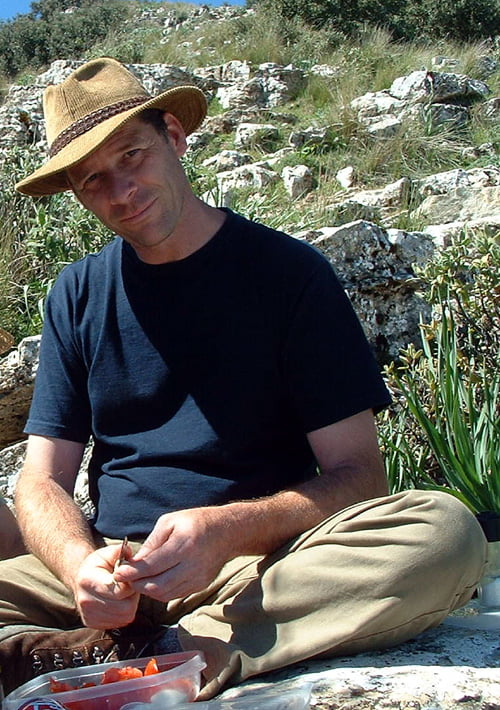
Clive Muir – Wildside Holidays – Walking, wildlife and culture holidays in Spain
I’ve been living in western Andalucía for more than 20 years and spend much of my time researching and running English-language travel websites about Spain. My work covers destinations including Cádiz, Ronda, Grazalema and the Caminito del Rey, as well as Wildside Holidays, which focuses on walking, wildlife and nature travel in Spain.
Through Wildside Holidays, I share practical information about Spain’s natural parks, mountains, wildlife and walking destinations, drawing on many years of living and travelling in the country. The aim is to help visitors discover Spain’s natural landscapes responsibly and plan rewarding walking and wildlife experiences.