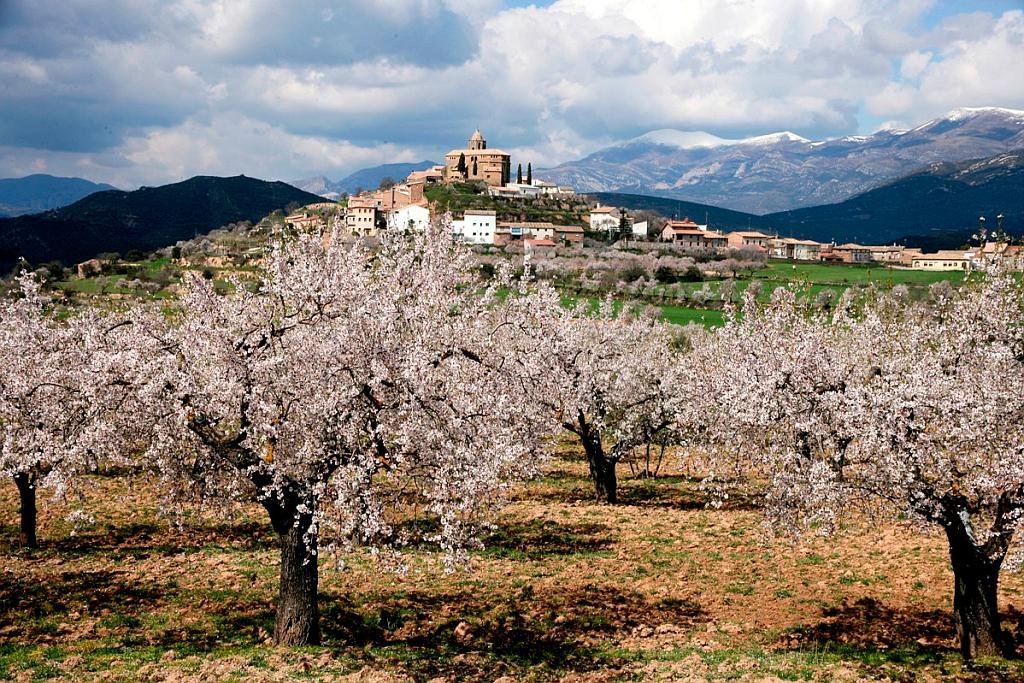
- Region: Aragón
- Province: Huesca
- Declared a Natural Park: 1990
- Park surface area: 47,453 hectares
- Villages and towns: Abiego, Adahuesca, Aínsa-Sobrarbe, Alquézar, Arguis, Bárcabo, Bierge, Boltaña, Caldearenas, Casbas de Huesca, Colungo, Huesca, Loporzano, Nueno and Sabiñánigo.
Points of interest
The Sierra y Cañones de Guara Natural Park (in Aragonese Parque natural d’a Sierra y as Foces de Guara ) is the largest protected area in Aragón located in the province of Huesca and covers the regions of Alto Gállego, Hoya de Huesca, Sobrarbe and Somontano de Barbastro.
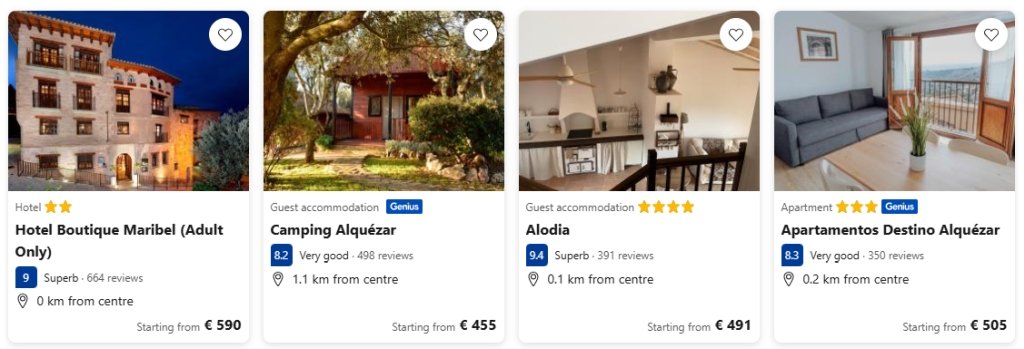
Find a hotel in the Sierra y Cañones de Guara Natural Park
I stayed at the Hotel Boutique Maribel in Alquézar, a lovely spot that perfectly matches the charm of the village. It’s a small, friendly hotel with a relaxed atmosphere and thoughtful touches that make you feel right at home. The rooms blend rustic stone walls with modern comfort, and some even offer great views of the surrounding hills. It’s an ideal base for exploring Alquézar’s winding streets, nearby trails, and the natural beauty of the Sierra de Guara.
Canyoning in the Sierra de Guara
One of the most popular sports activities in the Park is canyoning . The gorges of the main rivers, Vero, Mascún and Alcanadre attract numerous visitors making the area well known for this sport throughout Europe. Among the hundreds of ravines the most famous are:
- Barranco del Vero.
- Mascún ravine.
- Barranco de la Peonera.
- Gorgas Negras ravine.
Check out an organised canyoning day trip over at Get Your Guide.
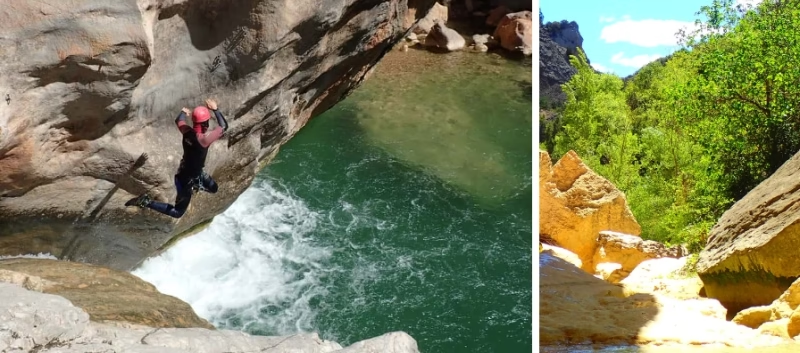
Thanks to its geology this area has become somewhat a Mecca for the practice of canyoning and climbing (In fact some would say that this is the area in Europe that first developed the sport of canyoning). The ravine of the Balcés river is more than 20 km in length and has cliffs as high as 800 m. The Grallera Alta de Guara chasm which has a vertical drop of 277 m.
Starlight destination
The area has also become famous as a starlight destination. The Starlight Foundation is a non-profit organization that was founded in 2009 to promote the protection of the night sky and the development of “astrotourism” and there is an ever growing list of starlight destinations in Spain to visit.
The whole area is noteworthy for its spectacular scenery and wildlife.
The climate is a hybrid of Atlantic and Mediterranean due to its location between the Pyrenees and the Ebro Valley . This marks the differences between the vegetation of the south and that of the north.
There are four rivers that cross the mountains and these have created the characteristic canyons: they are the Alcanadre, Flumen, Guatizalema, Vero and Mascún.
In Spanish, this short video show the spectacular scenery in the Sierra y Cañones de Guara Natural Park
Village to village hiking in the Sierra y Cañones de Guara Natural Park
Hike between the remote villages of the Sierra de Guara natural park. The park has perfect hiking weather in the spring and autumn. Your bags are moved between hotels each day so you just hike with a daypack. 6 days hiking taking you to the heart of this undiscovered area. Wonderful scenery with deep canyons, rocky limestone spires and abandoned villages. Find out more at Hike Pyrenees
Flora
One of the most notable characteristics of the vegetation in the Sierra y Cañones de Guara Natural Park is the contrast between the north and south slopes. On the northern slopes gall oak occupies large areas, followed in height by the forests of scots pine and beech groves. At higher altitudes there are forests of black pine and spruce.
On the southern slopes the Mediterranean forest takes control with holm oak being the predominant tree along with scots pine at higher altitudes.
Around the natural park the scrubland is also one of the most important plant formations especially boxwood heathers and kermes oak.
The Millennial “Carrasca de Lecina”, located within the Sierra y Cañones de Guara Natural Park and the Vero River Cultural Park.
In 2020 the “millenary holm oak” close to the town of Lecina in Huesca was elected “Tree of the Year in Spain”. Head for the town of Lecina. There is an easy marked footpath taking you to this emblematic tree.

Fauna
The steep ravine walls in the area facilitate the nesting of numerous species of cliff dwelling birds such as the Griffon vulture that is easy to identify by its characteristic circling flight when ascending in thermal currents. Keep your eyes open too for Bearded vulture and Golden eagle.

Among the mammals are wild boar, fox, wild cat, dormouse and beech marten.
The common brown trout frequents the river stretches anfd look out for Pyrenean newt in springs and ponds.
Also in the area
There are cave paintings from the Upper Paleolithic in the Fuente del Trucho. In the cave with a 20 m mouth opening and a depth of 24 m there are several panels with more than 100 cave paintings on the walls and ceiling as well as rock carvings on the floor. You can distinguish horses, bears, cervids, goats, negative hands and trilobed signs painted in red and black with an age between 25,000 and 30,000 years.
(The Fuente del Trucho cave is located at an altitude of 640 m, close to the fountain of the same name near the confluence of the Trucho or Arpán ravine and the Vero river, between the municipalities of Colungo and Asque. Currently the cave is closed to the public but there is a partial replica of it in the Vero River Rock Art Center in Colungo.) SEE INFORMATION CENTERS AT THE BOTTOM OF THIS PAGE FOR DETAILS.
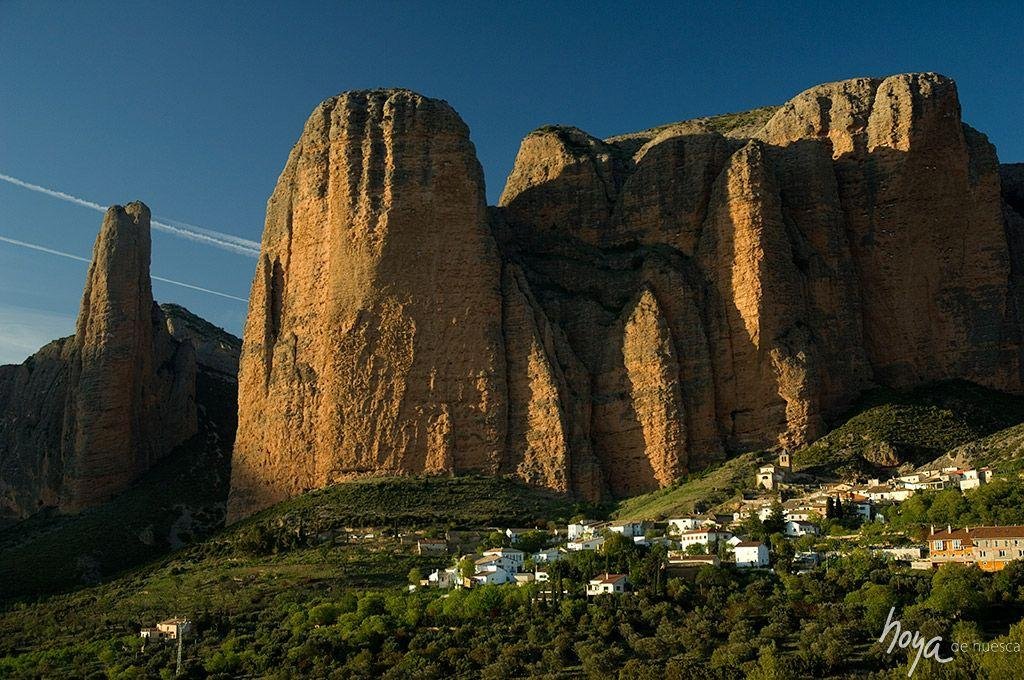
Mallos de Riglos
Not to far away from the town of Huesca (not inside the park limits) you will find the small village of Riglos. In 2022 it gained seventh place in the French newspaper El Monde “Most beautiful villages in the world awards”. As you can see by the below picture the setting is simply stunning.
Take a look at this spectacular short film
Mallos de Riglos is close to the Sierra y Cañones natural park in Aragón.
And Zaragoza is not too far away
Information/Visitors Centers
Hiking Trails in the Sierra y Cañones de Guara Natural Park
You can download pdf documents for hiking trails in the Sierra y Cañones de Guara Natural Park at this link. (They are in Spanish but contain good maps and images)
https://www.aragon.es/-/parque-natural-de-la-sierra-y-canones-de-guara
The natural park has several options for the interpretation of natural and cultural values and there are three interpretation centers that belong to the Aragón Natural Network. These centers provide interpretation and environmental education of the ecological diversity of the Sierra y Cañones de Guara Natural Park. They offer services such as the reception of visitors, basic information about the park, educational exhibitions and audiovisual projections. (ALL ARE WELL WORTH A VISIT)
Arguis Interpretation Center (Pascual Garrido Interpretation Center)
Location: The village of Arguis 23 kilometers from Huesca
Theme: The River Forest and the Fluvial Environment.
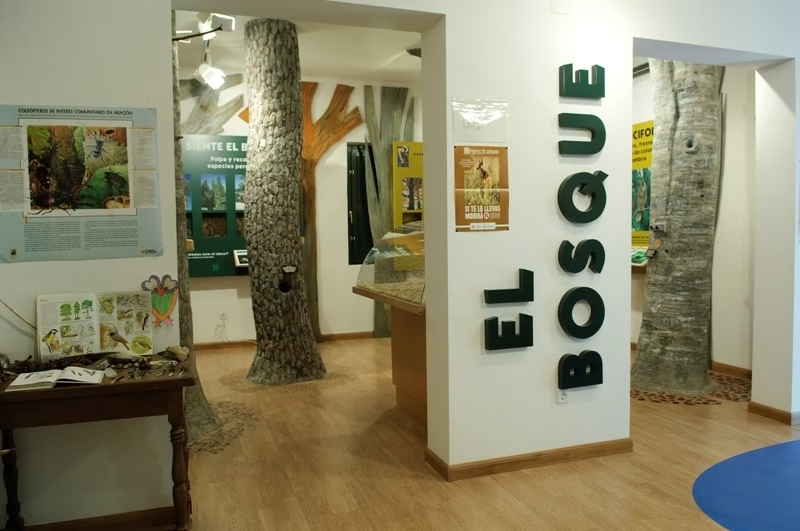
Audiovisual Projection, Interactive exhibition covering the subjects of Rock, ice, snow, canyons and cliffs.
Information Office of Santa Cilia de Panzano
Location : In the town of Santa Cilia de Panzano, along the Aguas a Bierge road. 32 kilometers from Huesca.
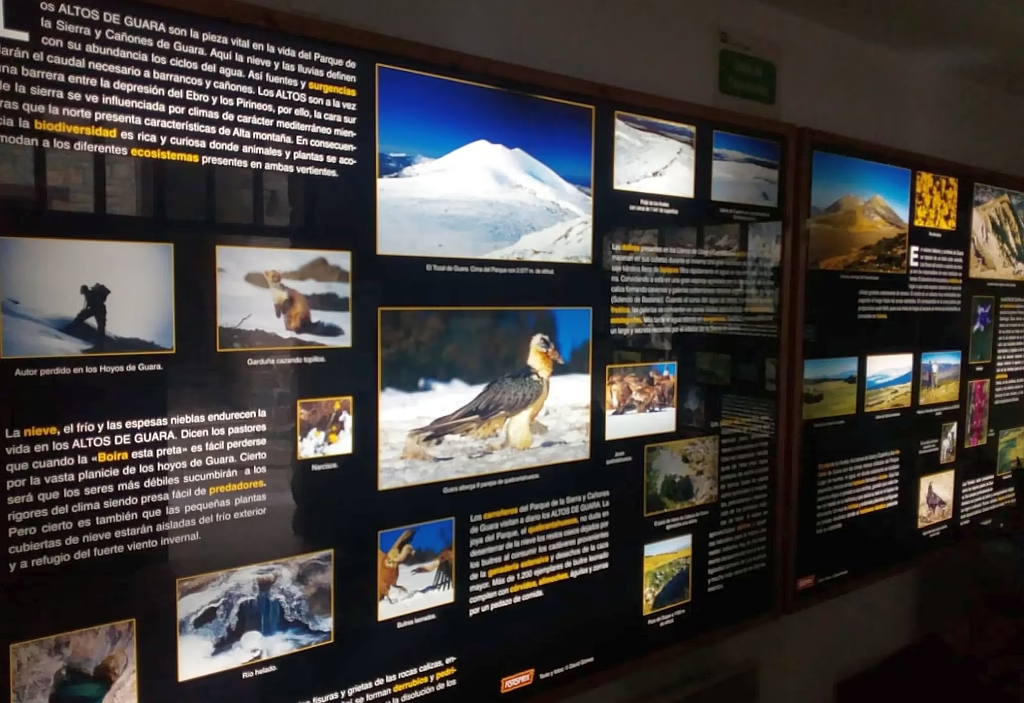
There is an interactive exhibition covering the subjects of the Mountains, Fauna and Flora and also “Man and his Relationship with the natural environment”.
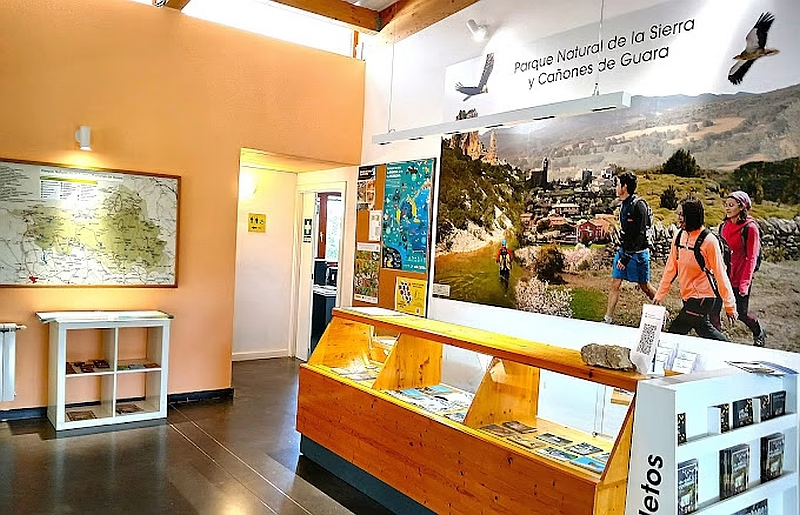
Interpretation Center of Bierge
Location: in the town of Bierge by the access road to the town of Rodellar, a few meters from the crossroads, the first detour to the left. 40 km from Huesca.
There is an excellent exhibition that is adapted to motor, visual and hearing disabilities and it focuses on the natural and cultural values of the Natural Park.
Calendar and Hours (Subject to change)
Autumn – winter: weekends and holidays, from 10 am to 2 pm and 3 pm to 6 pm
Spring – summer: weekends and holidays from 10 a.m. to 2 p.m. and 4 p.m. to 8 p.m.
Vero River Rock Art Center
The Cave Art Information Centre in the village of Colungo invites you to take a fascinating trip through the Prehistory of the River Vero, which has been declared a UNESCO World Heritage site. The extensive educational resources allow you to discover the creative genius of human beings, their beliefs and lifestyles.
Address: Las Braules, 222148 in the village of Colungo.
The centre has three exhibition areas, equipped with recreation facilities, models and audiovisual resources available in different languages.
- Museum House (“Casa Museo”) provides general information about cave art, the cultures of the inhabitants of the River Vero, and the natural environment.
- Archaeological Park (“Parque Arqueológico”) has several reproductions of Neolithic huts and burial constructions, such as dolmens and tumuli.
- Fuente del Trucho Cave Space explores the mystery of life through the art of the only cave in Aragon with Paleolithic paintings.
The tourism website of Hoya de Huesca is also an excellent source of information (Credit for the image at the top of this page)
https://turismo.hoyadehuesca.es/en/la-hoya-de-huesca/natural
For a great walk head for the nearby town of Alquézar
Ruta de las Pasarelas del Vero: A Riverside Adventure in Aragón
This scenic route takes visitors into the final stretch of the River Vero Canyon, where the stunning interplay of rock and water creates a harmonious natural landscape. Along the way, visitors can observe the immense efforts made over generations to harness the river’s power. The spectacular wooden footbridges, which are safe and easy to cross, provide access to one of the most unique and picturesque corners of Alquézar.
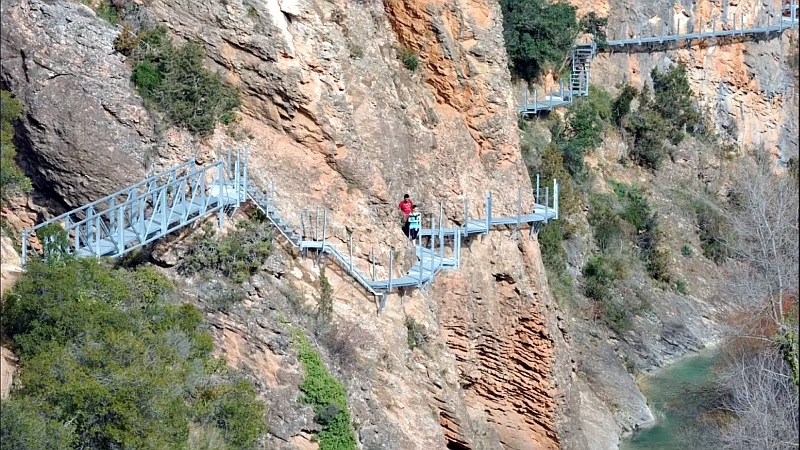
You can buy your entry tickets online here. (In Spanish.)
The walk begins in the Plaza Mayor in the heart of Alquézar. Follow the street leading to the collegiate castle, and at the first turnoff on the left, descend a stone ramp. Here, you’ll find the first sign marking the Pasarelas de Vero (Vero Footbridges).
Sierra y Cañones de Guara: Top Visitor Questions Answered
The Sierra y Cañones de Guara Natural Park in Huesca is renowned for its dramatic canyons, limestone cliffs, and clear rivers that have shaped a landscape ideal for hiking, canyoning, and wildlife watching. Its mix of Mediterranean and Atlantic climates supports diverse flora and fauna, including griffon vultures and bearded vultures. You’ll find more about its unique geology and trails further in the article.
Canyoning is the park’s signature adventure. Popular spots include the Mascún, Vero, and Peonera ravines—each offering a different mix of cliffs, pools, and waterfalls. Local guides in Alquézar and Rodellar organise safe trips for all levels. For maps and seasonal advice, check the official Aragón website linked in the main guide.
Spring and autumn are the most comfortable times to explore the park on foot. Temperatures are mild, the rivers flow gently, and the hillsides burst with colour. During these months, several “village-to-village” hiking routes operate with luggage transfer, letting you enjoy the scenery with just a daypack. Details of one such route are described in the full article.
Expect to see soaring griffon vultures, golden eagles, and even the elusive bearded vulture. The park’s forests shelter foxes, wild boar, and wild cats, while rivers host brown trout and the Pyrenean newt. Birdwatchers, in particular, will love the interpretive centre at Santa Cilia de Panzano, dedicated to cliff-dwelling species. A full list of fauna highlights appears later in the guide.
Yes — the Fuente del Trucho cave contains Paleolithic cave paintings over 25,000 years old. While the original cave is closed to protect the artwork, a detailed replica can be seen at the Vero River Rock Art Centre in Colungo, part of a UNESCO-listed site. This area also includes reconstructed Neolithic huts and dolmens that bring prehistory vividly to life.
Alquézar stands out for its medieval charm, boutique hotels, and easy access to the Pasarelas del Vero trail. Other good bases include Bierge, Rodellar, and Colungo, each offering different atmospheres—from peaceful stone guesthouses to family-run hotels. Accommodation options for all budgets are listed in the article, along with booking links.

Clive Muir – Wildside Holidays – Walking, wildlife and culture holidays in Spain
I’ve been living in western Andalucía for more than 20 years and spend much of my time researching and running English-language travel websites about Spain. My work covers destinations including Cádiz, Ronda, Grazalema and the Caminito del Rey, as well as Wildside Holidays, which focuses on walking, wildlife and nature travel in Spain.
Through Wildside Holidays, I share practical information about Spain’s natural parks, mountains, wildlife and walking destinations, drawing on many years of living and travelling in the country. The aim is to help visitors discover Spain’s natural landscapes responsibly and plan rewarding walking and wildlife experiences.
Comments are closed.