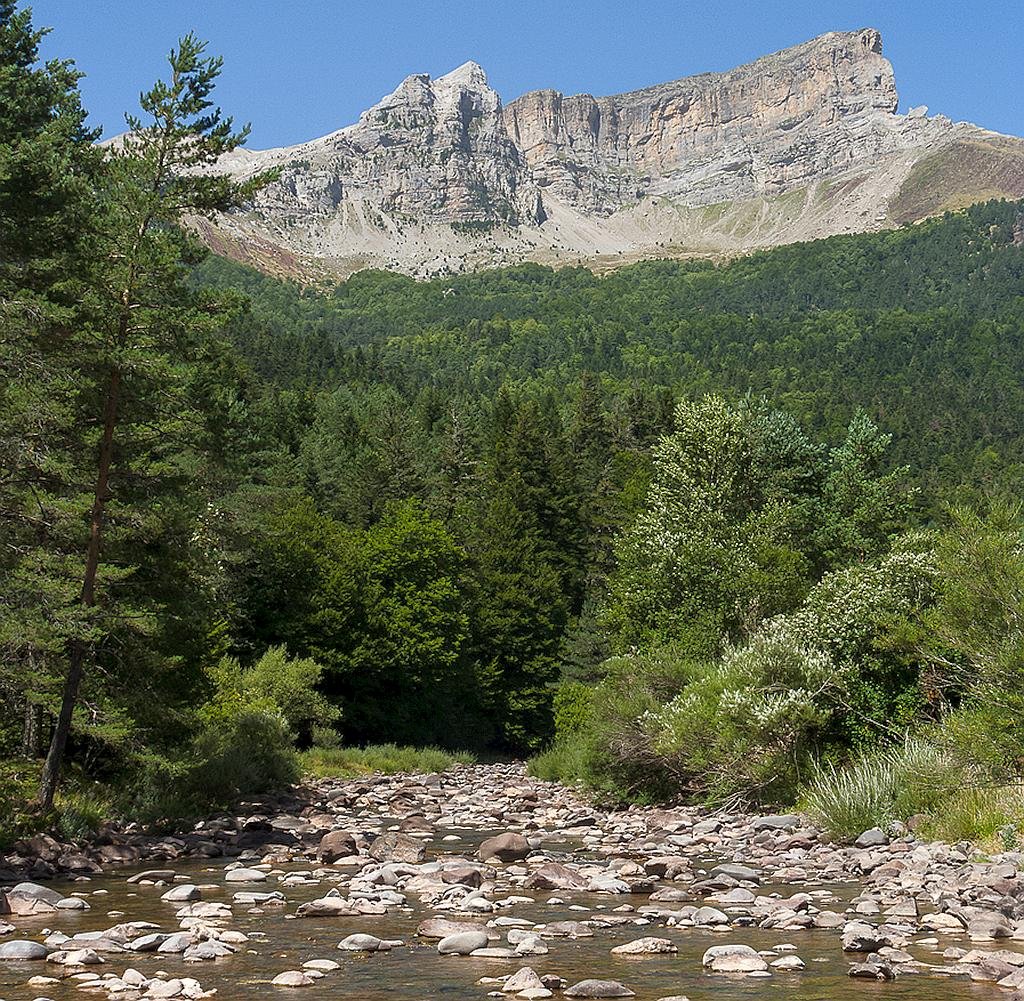
The Selva de Oza (Selba d’Oza in Aragonese) is a protected natural space located in the Hecho Valley (Huesca province), in the western part of the Aragonese Pyrenees . It is a natural space crossed by the waters of the Aragón Subordán river and surrounded by high mountain peaks between 2300 and 2700 meters. In the area the peaks of Peña Forca (2390 m), Punta Agüerri (2450 m), Castillo de Acher (2384 m) and Bisaurín (2668 m) stand out.)
The dense forest consists mainly of fir trees mixed with pine and beech and other species such as yew, maple and birch. In addition there is also huge variety of fungi, fruits and wild flowers.
In the forest and mountainous environment there are bear, ferret, roe deer, wild boar, badger, beech marten, fox, squirrel and otter.
In the sky keep a lookout for bearded vultures griffon vultures and golden eagles.The Aragón Subordán river also holds excellent stocks of trout.
The whole area is ideal for numerous sports and tourism activities and the stunning landscape is ideal for hiking, mountain biking, climbing, paragliding and in winter, cross-country skiing, mountain skiing, snowshoeing and back-country skiing.
Find a hotel in the Selva de Oza
The Selva de Oza area offers a small but distinctive range of accommodation options that suit visitors seeking nature, tranquility, and easy access to the Pyrenees. Travellers can stay at mountain hotels, such as Hotel de Montaña Uson, which provide comfortable rooms in a rustic, eco-focused setting.

The region also offers camping facilities, including tent pitches and simple lodging within forested surroundings at Camping Valle de Hecho. These options appeal to hikers, families, and outdoor enthusiasts who want direct access to trails, scenic views, and the quiet landscape of the Aragón Valley.
Dolmens, the abbey and the remains of one of the ancient Roman roads of Antonino Pío
Dolmens and stone circles
Some of the hiking routes allow you to discover traces that the ancient inhabitants left in the valley. One of the most interesting, due to its good conservation, is the dolmen in Aguastuertas, 1,600 meters above sea level (In the municipality of Ansó). it is accessed via the Selva de Oza, through the Guarrinza valley.
The Dolmen de Aguastuertas is one of many megalithic remains found in this area and around 80 monuments have been cataloged, creating what is considered to be the largest concentration of megaliths in the Pyrenean mountain range. In the Selva de Oza at the “Crown of the Dead”, there are also concentrations of huge stone circles that have been dated between 7000 and 5000 BC. Inside the stone circles, excavations have found flint arrowheads and small stone utensils that suggest that they are the remains of an ancient settlement used throughout history from prehistoric times to medieval times.
Abbey of San Pedro de Siresa
Buildings have existed at this site for centuries, possibly back to Visigothic times according to the excavations conducted in 1991. A Roman road (ruins of which remain today) passed nearby, connecting Zaragoza and Berdún (in the municipality of Canal de Berdún) to Béarn (France) through the 1,970 meter pass at Puerto de Palo. (More info at wikipedia)

Activities in the area from Get Your Guide
Information Centres
The town of Valle de Hecho has an excellent information centre with everything you need to get the best out of a visit to the area.
Web: https://www.valledehecho.es/informacion_turistica/oficina-turismo/39/
They also have a Facebook page:
https://www.facebook.com/OficinaDeTurismoDeHecho
The Interpretation Center of Pyrenean Megalithism and Val d’Echo
OBLIGATORY VISIT! 🙂 To find the Interpretation Center of the Pyrenean Megalithism follow the road that leads to the Selva de Oza and after 8 kilometers you will find the old Forest House (antigua casa forestal) at the beginning of the Boca del Infierno.
The exhibition is also available in English and through projections, reproductions and interpretive panels, “you will enter one of the most exciting worlds that the ancient inhabitants of the Pyrenees designed and built.”
There is also a cafe bar on site.
Opening times
- From the 15 June to September 15 open every day.
- From September 16 to June 14 open only on weekends and holidays. (Except Christmas Day and New Year’s Day).
- Opening times: 11:00 to 13:00 and 17:00 to 19:00.
Frequently Asked Questions About Exploring the Selva de Oza
The Selva de Oza stands out for its high-mountain scenery, dense fir and beech forests, and the dramatic peaks surrounding the Aragón Subordán river. Wildlife such as roe deer, wild boar and griffon vultures can often be spotted, while ancient dolmens add a fascinating cultural layer. The article explores how nature and heritage blend in this part of the western Aragonese Pyrenees.
Accommodation near the Selva de Oza ranges from rustic mountain hotels like Hotel de Montaña Usón to quiet forest campsites such as Camping Valle de Hecho. Both offer direct access to trails, viewpoints and historic routes. These options suit walkers, families and anyone who prefers staying close to nature. More recommendations are discussed in the main guide.
Yes, the valley contains one of the largest clusters of megalithic monuments in the Pyrenees. The Dolmen de Aguastuertas is among the best preserved, and the “Crown of the Dead” stone circles add an atmospheric touch to longer hikes. Excavations have revealed flint tools and ancient settlement traces. A fuller explanation of routes and access points appears in the article.
The area supports year-round adventures thanks to its varied terrain. Walking, climbing, mountain biking and paragliding attract visitors in summer, while winter brings opportunities for cross-country skiing, snowshoeing and ski touring. Because the river holds excellent trout stocks, fishing is another option. Seasonal tips and suggested itineraries are covered in the main text.
The Interpretation Centre of Pyrenean Megalithism, located at the entrance to the Boca del Infierno, offers a well-presented exhibition in multiple languages. Panels, reconstructions and short films explain the valley’s prehistoric culture and its remarkable concentration of monuments. The centre’s opening hours vary through the year, and more details are outlined in the article.
The abbey is often considered a highlight because it links centuries of Pyrenean history, from possible Visigothic foundations to its medieval role along an old Roman road. Its simple yet imposing architecture contrasts with the surrounding forested valley. Anyone exploring the area’s heritage will find it a rewarding detour. Further historical context is provided in the main guide.

Clive Muir – Wildside Holidays – Walking, wildlife and culture holidays in Spain
I’ve been living in western Andalucía for more than 20 years and spend much of my time researching and running English-language travel websites about Spain. My work covers destinations including Cádiz, Ronda, Grazalema and the Caminito del Rey, as well as Wildside Holidays, which focuses on walking, wildlife and nature travel in Spain.
Through Wildside Holidays, I share practical information about Spain’s natural parks, mountains, wildlife and walking destinations, drawing on many years of living and travelling in the country. The aim is to help visitors discover Spain’s natural landscapes responsibly and plan rewarding walking and wildlife experiences.