
- Region: Cantabria
- Local towns and villages: Bárcena Mayor, Arenas de Iguña, Cabuérniga, Cieza, Hermandad de Campoo de Suso, Ruente and Los Tojos
- Declared a Natural Park: 1988
- Park surface area: 23,932 hectares.
Points of interest
The Saja-Besaya Natural Park is located in an area between the hydrographic basins of the Saja and Besaya rivers extending from Monte Río los Vados in the extreme north to the Fuentes-Palombera and Sierra del Cordel (Campoo) mountains in the south. The largest protected area in Cantabria, the entire park is also integrated into the Saja National Hunting Reserve .
The geography of the Saja-Besaya natural park is characterized by deep valleys that have been excavated by the abundant rivers and streams tributaries of the Saja and Besaya. The diversity of its ecosystems is determined by the contrasting altitudes ranging from around 200 meters to the higher peaks of Cueto Iján (2,084 m) and Cueto Cordel (2,061 m).
Find a hotel close to the Saja-Besaya Natural Park
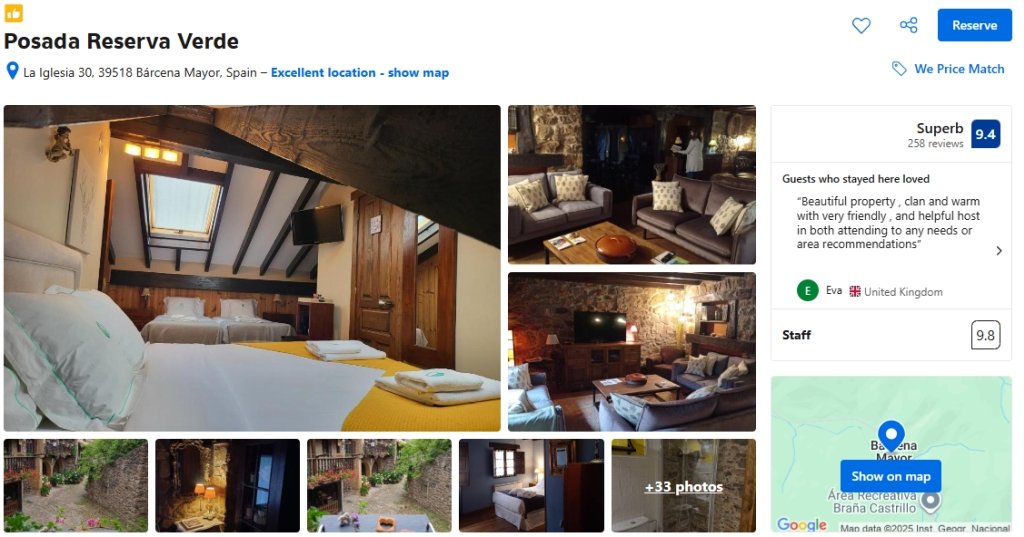
The only urban area located within the natural park boundaries is Bárcena Mayor, an ancient town and a superb example of mountain architecture. The Posada Reserva Verde is a great option for exploring the area.
The Posada Reserva Verde in Bárcena Mayor offers comfortable family rooms with private bathrooms, balconies, and mountain views, featuring walk-in showers, free toiletries, and parquet floors. Guests can relax on the terrace, enjoy free WiFi, and make use of amenities such as a lounge, room service, and a tour desk. The inn serves a continental or à la carte breakfast with local specialties, warm dishes, fresh pastries, cheese, and juice, and also provides a paid shuttle service.
Check out other lodgings, guest houses and apartments here.
The Saja Besaya Forest
The main attraction of Saja-Besaya is its deciduous forest, the largest contiguous forest of the entire Cantabrian mountain range.
A quarter of the park is covered by beech (Fagus sylvatica) and oak groves. The oak area of more than 6,000 ha. harbors three types, the most abundant is the common oak (Quercus robur) but also Quercus pyrenaica and Quercus petraea.
The forest is characterized by a diversity of trees and associated shrubs such as chestnuts, ash, maples, hazelnuts, honeysuckle, and varied flowering and herbaceous plants. With increasing altitude between 700 and 1,500 m the beech appears under which few species are able to thrive apart from the eye-catching anemone (Erythronium) and some orchid species.
Above 1,300 m. of altitude the holly trees (Ilex aquifolium) and birches (Betula pendula) take over.
The extension of the park is classified in several zones of uses: recreational, forestry, agricultural use, reserve and pasture. Tudanco cattle stand out in the areas where livestock is used. This is a breed of cow closely linked to the history and tradition of the area.
This protected area has a great wealth of fauna and flora. Among the numerous species, the wild boar, otter, Iberian wolf, golden eagle and roe deer stand out .
In the southern part of the park the Cantabrian brown bear is present.
Over 150 bird species have been recorded in the area including, golden eagle, eagle owl, griffon vulture and peregrine falcon.
Day trips and excursions from nearby Santander
Information/Visitors Centers
The Saja-Besaya Natural Park has a visitor center and six recreational areas:
- La casa del Monte – (Ucieda)
- Llano Castrillo – (Bárcena Mayor)
- Cambillas – (Saja)
- Cieza – (Cieza)
- El Prauco – (Los Llares)
- El Vaho – (Los Llares)
There is also the view point La Cardosa which is located on the CA-280 in direction of the mountain pass of Palombera, 4 km from the top at an altitude of 1000 meters.
Centro de Interpretación del Parque Natural Saja Besaya, Los Tojos
The Interpretation Center of the Saja-Besaya Natural Park is located immediately to the south of the town of Saja at PK 13 of the regional road CA-280 (Cabezón de la Sal-Reinosa), at the beginning of the ascent to the mountain pass of Palombera.
The spacious facilities have a projection room and a generous exhibition space in the old forest house and the old warehouse now houses a permanent photography exhibition on the ecological and landscape values of the Natural Park. The staff are well informed and can give you good information on hiking in the area and other activities.
Opening hours
- January to March from Wednesday to Friday from 10 a.m. to 3:30 p.m. and weekends and holidays from 10 a.m. to 6 p.m.
- April to June: Wednesday to Friday from 10 a.m. to 5 p.m. and weekends and holidays from 10 a.m. to 7 p.m.
- July and August: Monday to Sunday from 10 a.m. to 7 p.m.
- September: Tuesday to Sunday from 10 a.m. to 7 p.m.
- October and November: Friday from 10 a.m. to 5 p.m. and weekends and holidays from 10am to 6pm.
- December: Saturdays and Sundays from 10 a.m. to 6 p.m.
- Closed on 01/01, 06/01, 24/12 and 31/12
Website: https://redcantabrarural.com/ (In Spanish)
Essential FAQs for Visiting the Saja-Besaya Natural Park in Cantabria
The park lies between the Saja and Besaya river valleys, stretching from Monte Río los Vados in the north to the Fuentes-Palombera and Sierra del Cordel mountains in the south. It covers nearly 24,000 hectares, making it the largest protected area in Cantabria. The only village within its boundaries is Bárcena Mayor, a beautifully preserved mountain town.
Saja-Besaya is known for its vast deciduous forest — the largest in the Cantabrian range. Oak, beech, chestnut, and birch trees dominate its landscape, creating a mosaic of ecosystems rich in flora and fauna. From roe deer and wild boar to golden eagles and even the elusive Cantabrian brown bear, the park offers exceptional biodiversity worth exploring in more detail within the full article.
Visitors can explore the park on foot, by bike, or through guided tours. There are well-marked hiking trails leading to scenic viewpoints like La Cardosa, located at 1,000 metres on the CA-280. The Casa del Monte visitor centre in Ucieda and other recreation areas provide maps, picnic areas, and local information. More detailed routes and insider tips are included in the full guide.
The park supports over 150 bird species, including eagles, owls, and vultures. Larger mammals such as roe deer, wild boar, otters, and occasionally the Iberian wolf roam freely. During the autumn rut, visitors may witness the spectacular deer bellowing season. In the southern section, there’s even a chance—though rare—to spot the Cantabrian brown bear.
Bárcena Mayor offers the charming Posada Reserva Verde, ideal for exploring the park. Guests enjoy modern comforts with rustic style, local breakfasts, and mountain views. Other towns such as Cabuérniga, Ruente, and Los Tojos also have cosy inns and rural apartments. For more options, see the accommodation section in the full article.
Spring and autumn are the most rewarding seasons. In spring, wildflowers and fresh greenery fill the valleys, while autumn transforms the forest into a blend of gold, amber, and deep red. The deer rutting season in late September is particularly popular. Each season offers distinct colours, sounds, and wildlife encounters that define the park’s charm.

I’ve been living in this lovely area of Western Andalucia for the last 20 years or so and dedicate most of my time to the running of English language tourist information websites for the towns of Cádiz, Ronda, Grazalema, the famous or infamous Caminito del Rey, and also Wildside Holidays, which promotes sustainable and eco-friendly businesses running wildlife and walking holidays in Spain. My articles contain affiliate links that will help you reserve a hotel, bus, train or activity in the area. You don’t pay more, but by using them you do support this website. Thankyou!