- Region: Andalucia
- Provinces: Sevilla, Huelva, Cadiz
- Declared a Natural Park: 1969 reclassified in 1978
- In1963 WWF and the Council of Scientific Research bought land (6,794ha) and set up a research station
- In 1994 it became a UNESCO World Heritage Site
- Natural Park surface area: 54,200
- National Park surface area: 50,720 hectares – Total area: 77,260ha:
- World Heritage and Special Bird Protection Areas: 50,720ha.
- National Park and Ramsar site; buffer zone 26,540ha.
Towns and Villages
- Huelva: Almonte, El Rocio, Hinojos, Bollullos Par del Condado, Rociana del Condado, Bonanes y Lucena del Puerto, Palos de la Frontera, Moguer, La Puebla del Río and the Isla Mayor
- Sevilla: Aznalcázar, Pilas y Villamanrique de la Condesa.
- Cádiz: Sanlúcar de Barrameda
Points of interest
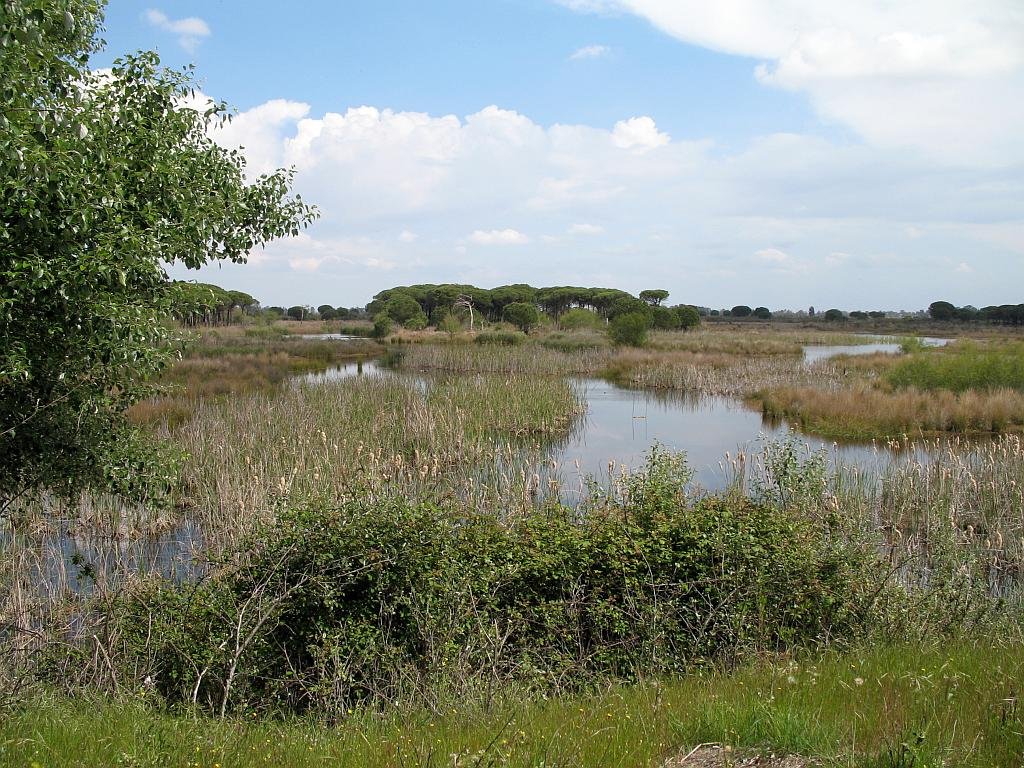
The Doñana National and Natural Parks occupy the northern area of the Guadalquivir river where it meets the Atlantic Ocean. Six thousand years ago it would have been a wide estuary, but this has mostly been closed off by a long, natural sand bar. This in turn created a large saline lake which gradually collected silt leaving a huge wetland area with lagoons, marshlands and semi-permanent sand dunes.
Some lake areas are saline and others are supplied by freshwater streams. Pine and oak woodland plus scrub or maquis further enhance the diversity of one of the most important habitats in Europe. This accumulation of varied ecosystems is capable of sustaining an incredible assortment of wildlife.
Used as hunting grounds for royalty from the 14th century, it was made a reserve in 1963 and a national park in 1969, and it remains the largest protected area in Europe.
The Doñana National and Natural Parks are on the main migration routes between Europe and Africa making it a favorite with ornithologists with as many as 250 species found in the reserve each year.
Organised Guided Day Trips to Doñana
There are some great day trips to Doñana available at Get Your Guide if you are staying in Seville, Cádiz or other towns and villages in Western Andalucia.
Find a hotel close to the Doñana National and Natural Parks
El Rocío offers plenty of places to stay, whether you’re looking for a simple guesthouse, a self-catering apartment, or a small hotel close to the village centre. Most options are within walking distance of local cafés, shops, and the famous hermitage, with practical features like Wi-Fi, parking, and air conditioning to make your stay comfortable.

When I visit, I usually stay at Hotel Restaurante Toruño. It’s well located, right by the main square and the marshes, which makes it easy to get around and enjoy the area. The rooms are comfortable, the staff are reliable, and the on-site restaurant means I don’t have to go far for a decent meal.
Flora
A diverse collection of around 750 species of plants exist through the different habitats. There are four main types of vegetation: marshland/aquatic, salt-tolerant, open forest and heathland.
- Marsh land types; Glasswort (Salicornia ramosissima), Seablite (Suaeda sp) and Perennial glasswort (Arthrocnemum perenne).
- Brackish lagoon types; Reeds (Juncus maritimus) and Cordgrass (Spartina alterniflora)
- Dunes type; European beachgrass (Ammophila Arenaria), Portuguese crowberry (Corema album), Buckthorn (Rhamnus) and Juniper (Juniperus macrocarpa).
- Inland dunes; Wild olive (Olea europea subsp oleaster) and Ash trees (Fraxinus angustifolia).
- Forest; introduced stone pine (Pinus pinea) and Eucalyptus sp.
- Heath lands; Tree heather (Erica scoparia), Heather (Erica ciliaris) Strawberry trees (Arbutus unedo) Thyme (Thymus tomentosa), Rosemary (Rosmarinus officinalis) and Lavender (Lavandula stoechas).
Four national endemics occur, each a protected species, Linaria tursica and grasses, Micropyropsis tuberosa, Gaudinia hispanica and Vulpia fontquerana.
Fauna
Mammals include the highly endangered Iberian Lynx (the closest to extinction of all the big cat species) Wild boar, Red deer, Fallow deer, Egyptian mongoose and European badger.
Reptiles, which are found especially in the dunes, include Spur-thighed tortoise (Testudo graeca), Chameleon (Chamaeleo chamaeleon), Lataste’s viper (Vipera latasti) and Spiny-footed lizard (Acanthodactylus erythrurus).
Common fish are carp (Cyprinus carpio) and Eel (Anguilla anguilla) plus a threatened species, the Iberian toothcarp (Aphanius iberus).
This huge list includes resident Greater flamingos, Spoonbills and summer breeding Little bittern, Purple heron with wintering Black stork and Osprey to name only a few. The park is also home to one of the world’s largest colonies of the Spanish Imperial Eagle.
The best times for birdwatchers are considered to be
- Spring; to see the influx of migrating birds arriving to breed, or rest before continuing their journey.
- Autumn; to see the selection of migrating birds that collect to rest and feed before their crossing into Africa.
- Winter; when the reserve is topped up by rain water and vast flocks of wildfowl – geese and ducks arrive in Doñana.
- The summer months see the wetlands begin to dry and many of the spring visitors depart with temperatures hitting 40 degrees Celsius leaving only the summer residents. Amongst the numerous species are Griffon Vultures, Booted eagles, Red-necked nightjars, Bee-eaters and Hoopoe. Spanish Imperial eagle (Aquila adalberti), Marbled Teal (Marmaronetta angustirostris), White-headed duck (Oxyura leucocephala) and Red-knobbed coot (Fulica cristata) are some of the rarities to look out for.
The Great Doñana drought of 2022/2023
In 2022 Doñana dried up completely putting huge stress in wildlife in the area. Read more here about the rainfall in 2025 that helped to save the wetlands.
The situation (in 2023) had become so desperate that the charity SEO birdlife has created a petition to stop a change in government policy to allow previously illegal water extraction and wells to be normalized. Read about it and sign the petition here: https://wildsideholidays.co.uk/save-donana-from-legalised-illegal-water-extraction/
The Buffer Zone
As well as the National Park of Doñana there is also a buffer zone (or pre-park area) around it, which is a designated Natural Park of Doñana (known in Spanish as Entorno de Doñana).
The National Park is under very tight protection, with public access restricted to its official visitor centres and some marked footpaths around them.
The Natural Park is less strictly protected with more open access but being a natural continuation of the National Park it is also of great importance for migratory and breeding birds, wildlife in general and tourism for the area
Research in the Park is of international scientific importance. Ornithological research has been carried out since the 1950s and studies have since been carried out on vertebrate zoology, botany, ecology, plant ecology, entomology, limnology, geography, ethnology, pesticides and diseases.
Also in the area of Doñana National and Natural Parks
Wood gathering, charcoal production, cattle-grazing, beekeeping and fish farming are traditional practices that occur within the park.
Market gardening forms a part of the agricultural land uses in the surrounding area. Rice farming covers over 38,000 hectares of former salt marsh areas with water from the Guadalquivir used for irrigation.
Intensive fruit farming (Strawberries) and illegal wells have caused issues over the years creating clashes between local farmers and ecologists
El Rocio
El Rocio is a small, sleepy lake side village of wide sandy streets whose focal point is the “Santuario de Nuestra Señora de el Rocio” Church. There is a religious festival at El Rocio each year coinciding with Whitsunday which brings approximately a million pilgrims from every part of Spain. There is an explosion of music, dance, traditional dress and flower adorned wagons, drawn by mule or oxen.
For the rest of the year the village remains virtually uninhabited.
Information/Visitors Centers
Remember that the Doñana area is huge and has quite a few “official” interpretation centres. However, most towns and villages in the area also have their own municipal information centres. Your first resource for guides and leaflets for the area would also be your hotel reception.
La Rocina (Information Centre, walks and hides)
In the village of El Rocio, this visitor centre has a nice and accessible, easy hike with a few observation points overlooking the marshes. The path also takes you through some other ecosystems such as the scrubland.
El Acebuche (Information centre, café, walk-ways and hides)
Close to El Rocio on the road to Matalascañas this Center (OBLIGATORY VISIT IF YOU ARE IN THE AREA) offers an excellent information service to visitors. There is normally a live TV feed showing the current captive breeding area of the Iberian lynx. There is also an audiovisual room and well marked footpaths to hides and areas of marsh and scrubland.
El Acebuche is also the start point for guided visits to the National Park of Doñana in all-terrain vehicles, accompanied by guide-driver, on a route of around 70 kms. This guided route takes you through the different ecosystems of the National Park.
Palacio del Acebrón
(On the A-483 take the turning for La Rocina and El Acebrón. Once you have passed the La Rocina visitor centre continue for 6 kilomtres on the H-9021)
Once a private hunting estate the an ethnological museum inside in very interesting with lots of detail and is free to enter
José Antonio Valverde (water side café/hide and great information)
Road access not well marked and from Villamanrique de la Condesa, Puebla del Río and Isla Mayor it is about 25 km. Access is through unpaved tracks. Ask in your hotel or other visitor centre to double check opening times before you make the trip!
This Visitor Centre is located on a small hill known as Cerro del Palo, from which there is a great view of the Laguna de la Fuente de Piedra. (Not to be confused with Fuente de Piedra in the province of Malaga.) Inside there is a fantastic view from the large windows that looks out onto the lagoon. There is also an excellent exhibition of photographs of the lagoons and other wetlands of Andalusia.
Ask about guided tours for wildlife watching.
The center was named after Jose Antonio Valverde. A biologist and ecologist born in 1926 in Valladolid who was one of the pioneers of the conservation of wetlands in Andalusia. He died in Seville
In 2003.
Fábrica de hielo (Ice Factory).
At the southern point of the Guadalquivir estuary. (Av. Bajo de Guía, S/N, 11540 Sanlúcar de Barrameda)
This interpretation centre offers an overview of the area from the flora and fauna that make up the landscape to the richness of the marine ecosystem associated with the mouth of the Guadalquivir.
Dehesa Boyal near Villamanrique de la Condesa. Camino del Bujeo in front of the sports ground.
The excellent Dehesa Boyal visitors centre is in the village of Villamanrique de la Condesa. It offers visitors general information about the Natural Park of Doñana and the fauna and flora of the area and an exhibition detailing traditional uses and exploits of nearby populations such as coal production, pineapple harvesting, beekeeping, cork mining and cotton are also part of the sample.
This centre also arranges guided visits, hiking, horseriding and is a popular destination for schools for education courses. (See the website here.)
Essential FAQs about Doñana National and Natural Parks, Andalucia
Doñana National Park is one of Europe’s most important wetlands, lying where the Guadalquivir River meets the Atlantic Ocean. Its mix of marshes, dunes, lagoons, and forests supports hundreds of bird species and rare animals like the Iberian lynx. The park’s rich biodiversity and its role as a key migratory stopover make it truly unique. More details about its ecosystems can be found in the main article.
Spring and autumn are the most rewarding times for birdwatchers. In spring, migrating birds arrive from Africa to breed, while autumn brings large flocks preparing to return south. Winter also draws thousands of ducks and geese after the seasonal rains. Summer is quieter but still offers raptors and resident species.
Yes — but access rules differ. The National Park has stricter protection, with visits only allowed on guided tours or through designated visitor centres like El Acebuche. The Natural Park, forming a buffer zone, allows freer exploration by car, bike, or foot. Each offers different ways to experience Doñana’s wildlife and landscapes.
Visitors might spot the elusive Iberian lynx, wild boar, red deer, and a range of reptiles such as chameleons and spur-thighed tortoises. Birdlife is the main draw though — from flamingos and spoonbills to the rare Spanish imperial eagle. The mix of saltwater, freshwater, and forest habitats makes sightings wonderfully varied.
During the 2022–2023 drought, many lagoons dried out completely, causing major stress to wildlife. Rainfall in 2025 began restoring some marshes, but water extraction for farming remains a threat. Conservation groups continue to campaign for stricter water management — the article explains how to support these efforts.
Several centres help visitors explore the park responsibly. El Acebuche near El Rocío is the main hub, with walking trails and live lynx feeds. La Rocina, Palacio del Acebrón, and José Antonio Valverde offer guided walks and exhibitions. Each provides insight into different ecosystems — it’s worth visiting more than one.

Clive Muir – Wildside Holidays – Walking, wildlife and culture holidays in Spain
I’ve been living in western Andalucía for more than 20 years and spend much of my time researching and running English-language travel websites about Spain. My work covers destinations including Cádiz, Ronda, Grazalema and the Caminito del Rey, as well as Wildside Holidays, which focuses on walking, wildlife and nature travel in Spain.
Through Wildside Holidays, I share practical information about Spain’s natural parks, mountains, wildlife and walking destinations, drawing on many years of living and travelling in the country. The aim is to help visitors discover Spain’s natural landscapes responsibly and plan rewarding walking and wildlife experiences.
Doñana is absolutely incredible, as this guide perfectly highlights with its huge list of everything from rare lynxes to twitching birdwatchers! I love how it mentions the 2022/2023 drought – a stark reminder that even Europes most important wetlands need our help, especially with those pesky illegal wells. The guide to the visitor centres is a lifesaver; navigating Doñana without one is like trying to find the Spanish Imperial Eagle without binoculars! And El Rocio festival sounds like a proper Andalucian party – a million pilgrims and flower-adorned wagons? Sign me up (if I wasnt already living here, that is). Well done for promoting sustainable holidays; I always enjoy reading about the areas unique wildlife and the efforts to protect it, even if it does make me slightly worry about that 40-degree Celsius summer!