
- Region: Asturias.
- Park surface area: 37,700 hectares.
- Declared a Natural Park: 1996.
- Declared a UNESCO Biosphere Reserve; 2001.
- Site of Community Importance.
- Special Protection Area for Birds (ZEPA).
- Towns and villages in the area: Caso, Sobrescobio.
Points of interest
The Redes Natural Park is mostly covered by large wooded areas, among which its endless beech forests are striking. It is located in the eastern / central area of Asturias. At high altitude there is evidence of glacial erosion that occurred during the Pleistocene period. This glacier modeling allows you to see wide glacial cirques and valleys.
This is an impressive karst landscape with many chasms and sinkholes and there are also high moorlands, pastures and also chestnut plantations. Redes Natural Park is home to all the characteristic species of the north of the peninsula such as the brown bear, capercaillie and Iberian wolf as well as the largest populations of chamois and deer in Asturias.
Fantastic promo video by Turismo Asturias about the Redes natural park
One of the most visited places in the park is the plain of Brañagallones. here you can find the typical braña vaqueira (mountain shelter for farmers and animals) where there is now a mountain refuge for hikers.
Flora
The vegetation is dominated by forests of beech and oak especially in the upper parts of the basins of the Nalón and Ponga rivers. Holly, yew and ferns such as Trichomanes speciosum are also present. In the Llagu Ubales area the reed fern (Isoetes velatum) is present. This is a species of ecological value, highly protected and can also found in the Arbás Lagoon. In the area of the Pico Vamartín peat bogs there is a population of woolly reed (Eriophorum angustifolium) which is the only one existing in Asturias.
Find a hotel in the Redes Natural Park
Redes Natural Park in Asturias offers a diverse array of accommodations, catering to various preferences and budgets. Whether you’re seeking a rustic retreat or a comfortable base for outdoor adventures, you’ll find suitable options in the surrounding towns and villages. Rioseco is a great village to base yourself and this two bedroom converted barn is perfect.
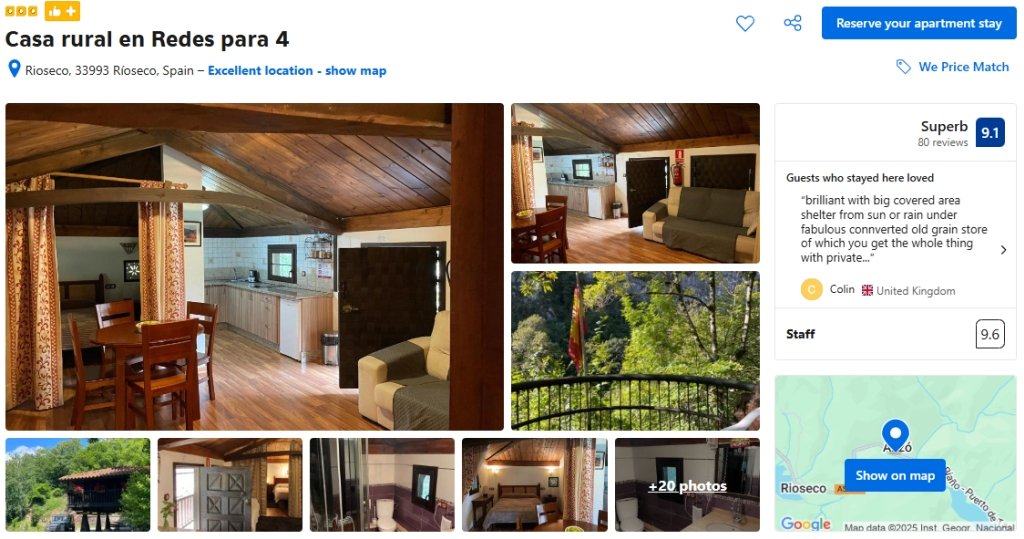
See more places to stay in the Redes Natural park over at Booking.com.
Fauna
In addition to the iconic Iberian wolf and Cantabrian brown bear present in the Natural park, other mammals include the brown hare (Lepus castroviejoi), the Iberian desman (Galemis pyrenaicus), an insectivore that inhabits streams and rivers with clean and oxygenated waters. Chamois (Rupicapra pyrenaica parva), roe deer (Capreolus capreolus), red deer (Cervus elaphus), wild boar (Sus scrofa), Stone Marten (Martes martes), badger (Meles meles), wild cat (Felis silvestris), fox (Vulpes vulpes), Iberian mole (Talpa occidentalis) and grey dormouse (Glis glis).
We can also find some species of chiropterans such as the small horseshoe bat (Rinolophus hipposideros) Mediterranean horseshoe bat (Rinolophus euryale ), large horseshoe bat (Rinolophus ferrun-equinum), long-tailed bat (Tadarida teniotis), the dwarf bat (Pipistrellus pipistrellus) and the riparian bat (Myotis daubentoni).
The diversity of birdlife in the park is very high, thanks also to the different and varied types of habitats. The presence of the Cantabrian grouse (Tetrao urogallus) is of great interest , a species ” in danger of extinction” that lives in the extensive beech forests of the Park. Also present are golden eagle (Aquila chrysaetos), Egyptian vulture (Neophron percnopterus), peregrine falcon (Falco peregrinus), goshawk (Accipiter gentilis), alpine sparrow (Montifringilla nivalis) and grey partridge (P. perdix). in higher areas you may be very lucky to spot the black woodpecker (Dryocopus martius).
In addition to a variety of snakes, such as the southern smooth snake (Coronella girondica), the European smooth snake (Coronella austriaca ) and the collared or water snake (Natrix natrix ) in this area two lacértids are worth highlighting as they are Iberian endemisms. Schreibers black-green lizard (Lacerta schreiberi) and the Iberian rock or “mountain” lizard (Iberolacerta monticola). The males of the former are very striking in mating season due to the strong blue color of their heads. They are usually seen on the edges of forests and in rocky and high mountain thickets.
Also in the area
Guided Tours with Get Your Guide in the Redes Natural Park and Covadonga Area
Discover the stunning beauty of northern Spain with a guided tour through the Redes Natural Park and the Covadonga area. These tours, available through Get Your Guide, offer an immersive experience in one of Asturias’ most breathtaking landscapes. Explore lush valleys, crystal-clear rivers, and charming mountain villages while learning about local wildlife, history, and traditions from expert guides. Whether you’re hiking scenic trails, visiting the iconic Covadonga Lakes, or enjoying authentic Asturian cuisine, each tour provides a perfect mix of adventure and culture for nature lovers and curious travelers alike.
Information/Visitors Centers
Redes-Caso Nature Park Reception and Interpretation Centre.
The Reception and Interpretation Center of the Redes Natural Park is located in the town of Campo de Caso on the road towards Puerto de Tarna.
In the interpretation center you will find all the information you need to get the most out of a visit to the Redes Natural Park. There is a permanent exhibition covering the geology, flora, fauna and culture of the area through photographs and explanatory texts. There is also an audiovisual room with capacity for 50 people showing a film about the area, its people and wildlife.
Opening times
October 1 to May 31.
Tuesday to Saturday, and holidays: From 9:30 a.m. to 2:00 p.m. and from 4:00 p.m. to 6:00 p.m.
Sunday: From 9:30 a.m. to 2:00 p.m.
Monday: closed.
June 1 to September 30
Monday to Saturday, and holidays: From 9:30 a.m. to 2:00 p.m. and from 4:00 p.m. to 7:00 p.m.
Sunday: From 9:30 a.m. to 2:00 p.m. and from 4:00 p.m. to 6:00 p.m.
Web: https://www.parquenaturalderedes.es (In Spanish)
Essential FAQs for Visiting Redes Natural Park in Asturias
Redes Natural Park lies in eastern-central Asturias, covering 37,700 hectares of mountains, valleys, and beech forests. Declared a natural park in 1996 and a UNESCO Biosphere Reserve in 2001, it includes the towns of Caso and Sobrescobio and forms part of a Special Protection Area for birds (ZEPA), making it a hotspot for wildlife enthusiasts.
Redes is renowned for its extensive beech forests, glacial valleys, and karst landscapes with sinkholes and moorlands. Visitors can explore ancient pastures, chestnut groves, and pristine rivers while spotting rare species like the Cantabrian brown bear, Iberian wolf, and chamois. Its combination of high-altitude meadows and lush forests makes it a remarkable example of northern Spain’s natural heritage.
The park offers hiking trails, guided tours, and scenic walks, including the famous Brañagallones plain with its historic mountain shelters. The Redes-Caso Reception and Interpretation Centre provides maps, exhibitions, and audiovisual presentations about the park’s flora, fauna, and culture. Guided tours through the park and nearby Covadonga Lakes are also available for an immersive experience.
Wildlife here is abundant. Mammals include Iberian wolves, brown bears, chamois, roe and red deer, wild cats, otters, and stone martens. Birdwatchers can spot Cantabrian grouse, golden eagles, Egyptian vultures, and peregrine falcons. Streams and rivers host the rare Iberian desman. The park is also home to striking reptiles like Schreibers black-green lizards and Iberian rock lizards, often seen on forest edges or rocky highlands.
Spring and summer bring lush green forests, wildflowers, and active wildlife, while autumn paints the beech forests in rich golds and reds. Winter is quieter but offers snow-dusted landscapes for hikers and photographers. Each season reveals a different aspect of the park, making it rewarding to visit year-round depending on the experience you seek.
Villages like Rioseco and Campo de Caso provide rustic lodgings, converted barns, and family-friendly inns with mountain views. Many accommodations offer easy access to hiking trails and local attractions. For more options, the full article includes recommendations for cosy retreats and practical tips for booking your stay in Asturias’ heartland.

Clive Muir – Wildside Holidays – Walking, wildlife and culture holidays in Spain
I’ve been living in western Andalucía for more than 20 years and spend much of my time researching and running English-language travel websites about Spain. My work covers destinations including Cádiz, Ronda, Grazalema and the Caminito del Rey, as well as Wildside Holidays, which focuses on walking, wildlife and nature travel in Spain.
Through Wildside Holidays, I share practical information about Spain’s natural parks, mountains, wildlife and walking destinations, drawing on many years of living and travelling in the country. The aim is to help visitors discover Spain’s natural landscapes responsibly and plan rewarding walking and wildlife experiences.
Comments are closed.