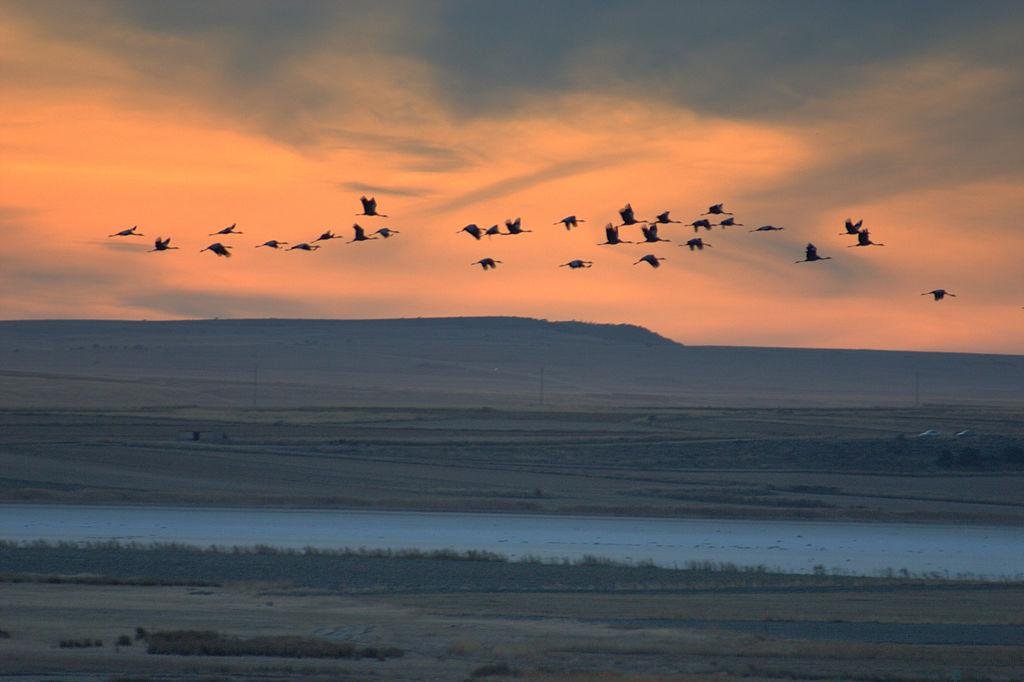
Without a doubt, one of the most distinctive living elements of the Laguna de Gallocanta are the birds, especially the striking flocks of common cranes that rest and feed here during the course of their migratory trips.
The vast majority of the European crane population moving on the western migratory route use Gallocanta as a feeding and resting area. Over 100,000 cranes have been counted in a single day (02/24/2011) and its normal for 40,000 to 60,000 individuals to be present during an average migratory season.
Flocks of common cranes arrive en masse at dusk after spending the day feeding in the outlying fields. This has to be one of the most impressive visual and sound spectacles of nature.
Best time to visit the area is during the months of November to February.
The protected area covers 1.924 hectares of natural reserve (the wetland itself) and 4.553 hectares of peripheral protection zone (the surrounding farmland sometimes is also wetland depending on rainfall)
Towns and Villages close to the Laguna of Gallocanta
The Laguna de Gallocanta is surrounded by a number of small villages and towns, mostly in the province of Teruel and partly in Zaragoza, Aragón. The nearest ones include:
- Gallocanta – The village closest to the lagoon, giving the lake its name. Small and quiet, with easy access to observation points.
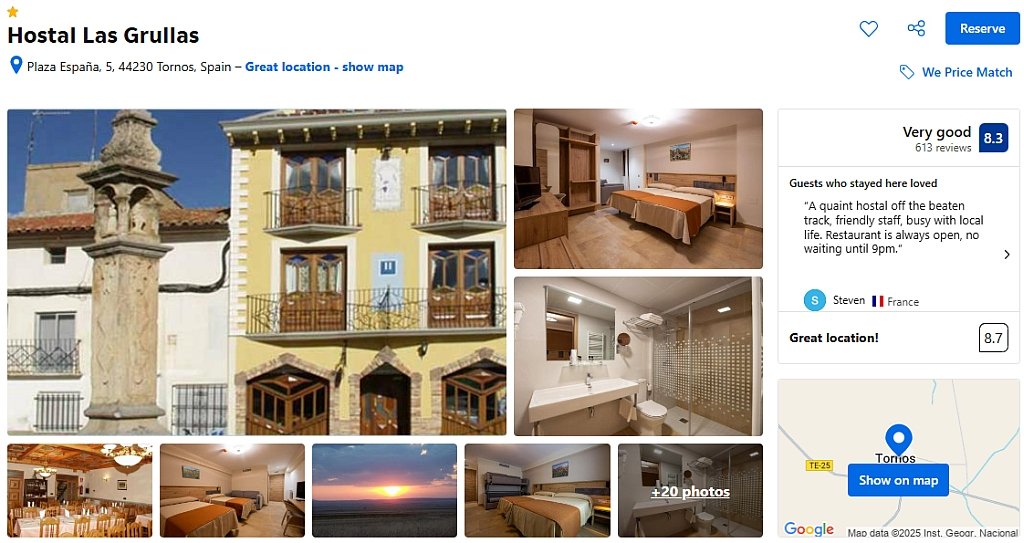
- Tornos – About 3 km from the lagoon, it’s where Hostal Las Grullas is located and a popular base for crane watching.
- Bello – Close to the Interpretation Centre, convenient for visiting the main exhibitions and trails.
- Berrueco – Near the starting point of the Berrueco trail, with a castle and panoramic views of the lagoon.
- Daroca – A slightly larger town south of the lagoon, providing additional amenities and historical sights.
- Calamocha – North of Gallocanta, offering services, restaurants, and connections to surrounding areas.
Other smaller hamlets such as La Zaida and Guialguerrero are nearby, especially if you want to explore the smaller surrounding lagoons.
Find a hotel close to the Laguna de Gallocanta
We spent three nights at Hostal Las Grullas in Tornos with our family, and it was a wonderfully relaxing stay. The village sits near Laguna de Gallocanta, where thousands of cranes gather, creating a breathtaking sight right from the lakeside. The hotel itself was cozy, and the friendly hosts made us feel at home. Strolling the quiet streets and watching the cranes over the lagoon made it a memorable and peaceful family getaway.
The Magic of the Cranes
Starlight Destination
The area has also become famous as a starlight destination. The Starlight Foundation is a non-profit organization that was founded in 2009 to promote the protection of the night sky and the development of “astrotourism” and there is an ever growing list of starlight destinations in Spain to visit.
Aragón Active Holidays arrange bird watching trips to Gallocanta

Where and what is Gallocanta?
The Gallocanta Lake (Spanish: Laguna de Gallocanta) is an endorheic lake in the province of Aragon. It is within the boundaries of two provinces, Teruel and Zaragoza, and is located just to the south of Gallocanta village, between the Aragonese comarcas of Campo de Daroca and Comarca del Jiloca. This lake is situated on a high continental plain at an altitude of almost 1,000 m
The interpretation center of the Gallocanta lagoon (obligatory visit to get the best out of the area)
Location: in an old road laborer’s house located on the A-1507 road, between the villages of Tornos and Bello. 120 km from Zaragoza and 95 km from Teruel.

Gallocanta Lagoon
The main content of the interpretation centre is the natural history of the lagoon, its history and formation and the uniqueness of the species it provides a home for with special emphasis on the common crane.
There is also an audiovisual projection and an interactive exhibition covering the geology of the lagoon, the habitat and human existence in the area.
Opening times Spring-Summer (from March 21 to September 20)
Mornings: 10:00 to 14:00
Afternoons: 15:00 to 18:00
Opening times Autumn-Winter (from January 24 to March 15 and from September 26 to December 20)
Mornings: 10:00 a.m. to 2:00 p.m.
Afternoons: 3:00 p.m. to 7:00 p.m.
Telephone: 978 734 031
Telephone (central offices): 976 07 00 00
Website: https://www.aragon.es/-/reserva-natural-de-la-laguna-de-gallocanta (Spanish)
Places to visit and parking
- Centro de Interpretación de la Reserva Natural de la Laguna de Gallocanta.(see above info about the intepretation centre)
- Mirador de la Ermita de la Virgen del Buen Acuerdo.
- Observatorio de Gallocanta.
Parking
- Centro de interpretación de la Reserva Natural Dirigida de la Laguna de Gallocanta (Bello).
- Ermita Nuestra Señora del Buen Acuerdo (Gallocanta).
- Centro de visitantes y museo de las Aves (Gallocanta).
Walking Trails
Path PR-Z 33 La Laguna de Gallocanta and los Lagunazos. (32 Km – 9 hours – Circular)
This footpath is circular and goes completely around the lagoon passing by the 5 observation hides and the Ermita de la Virgen del Buen Acuerdo from where there is also an excellen view of the Lagoon. This path can also be made by bike. Its not obligatory to do the whole footpath, just walk as far as you want then turn around.
Berrueco trail (1km – 30 mins – Linear
This is a Linear path, which starts from the town of Berrueco and ascends to its Castle, from where you can see a magnificent panoramic view of the Gallocanta Lagoon.
Observation hides
- Torre-observatorio del Cañizar.
- Observatorio de los Aguanares.
- Observatorio de la Ermita.
- Observatorio de los Ojos.
- Torre-observatorio de La Reguera.
- Obvervatorio del Centro de Interpretación de la Reserva Natural de la Laguna de Gallocanta.
- Observatorio accesible de Gallocanta.
Recreation and picnic sites
- Fuente de los Haces.
- Fuente Sancho.
- Church of the Ermita de la Virgen del Buen Acuerdo.
- La Serna.
- Gallocanta swimming pool.
Museums
- Gallocanta avian museum (Inside the Gallocanta visitor centre).
Other lagunas in the area
- Laguna de La Zaida.
- Laguna de Guialguerrero.
Renting hides at the Laguna de Gallocanta
Request processing is carried out by the Servicio Provincial en Teruel del
Departamento de Agricultura, Ganadería y Medio Ambiente, Subdirección de Medio Ambiente, placed in C/ San Francisco, 27 de Teruel (44071).
Telephone +34 978 64 11 45
Email address: hidesgallocanta@aragon.es.
Dowload the full guide to renting a hide here
https://www.aragon.es/documents/20127/12362674/How+to+book+hides+-+Reserva+Natural+Dirigida+de+la+Laguna+de+Gallocanta+-+2020.pdf/2925f255-4585-6d6e-6691-9ac7ab57cedf?t=1597824000140
This area also borders with the Maestrazgo global geopark: https://wildsideholidays.co.uk/maestrazgo-global-geopark/
Frequently Asked Questions About Visiting Laguna de Gallocanta
The peak season for observing common cranes at Laguna de Gallocanta is between November and February. During this time, thousands of cranes arrive daily to rest and feed. On particularly active days, counts can exceed 100,000 birds. Visiting in these months provides the most spectacular visual and acoustic experience. More details on timing and tips are in the full guide.
Birdwatching hides can be reserved through the Teruel Provincial Service, part of the Department of Agriculture and Environment. Bookings require contacting them by phone or email, and a full guide is available online. Renting a hide lets you observe cranes up close without disturbing them, making it ideal for photographers and wildlife enthusiasts.
The Interpretation Centre offers interactive exhibitions on the lagoon’s geology, natural history, and migratory species, particularly the common crane. Visitors can also enjoy audiovisual presentations explaining the unique ecology of the area. Visiting the centre is recommended to fully appreciate the lagoon’s significance before exploring its trails and observation points.
Yes, Hostal Las Grullas in Tornos is a popular choice. Families can enjoy a cosy stay with friendly hosts, quiet streets, and easy access to the lagoon. From here, watching thousands of cranes and exploring local trails is straightforward. The location is ideal for a peaceful getaway combined with wildlife observation.
Several trails circle the lagoon, including the 32 km PR-Z 33 circular path and the shorter Berrueco trail. Key observation points include Torre-observatorio del Cañizar, Observatorio de la Ermita, and the accessible observatory at the Interpretation Centre. You can walk part of any trail or complete it entirely, offering flexibility for all fitness levels.
Beyond birdwatching, the area is recognised as a Starlight Destination, ideal for observing the night sky. The Starlight Foundation promotes dark sky protection and astrotourism. Visitors can enjoy clear night skies with minimal light pollution, combining wildlife observation with astronomy experiences for a unique visit.

I’ve been living in this lovely area of Western Andalucia for the last 20 years or so and dedicate most of my time to the running of English language tourist information websites for the towns of Cádiz, Ronda, Grazalema, the famous or infamous Caminito del Rey, and also Wildside Holidays, which promotes sustainable and eco-friendly businesses running wildlife and walking holidays in Spain. My articles contain affiliate links that will help you reserve a hotel, bus, train or activity in the area. You don’t pay more, but by using them you do support this website. Thankyou!