- Region: Valencian Community
- Province: Alicante
- Declared a Natural Park: 1994
- Park surface area: 2,470 hectares
- Towns and villages: Elche, Santa Pola
Points of interest
The Salinas de Santa Pola Natural Park (Salines de Santa Pola in Valencian) is located in the Bajo Vinalopó region in the south of the province of Alicante and this wildlife habitat is a excellent example of human industry and nature symbiosis since its formation is due to the development of the extraction activity of the Bras del Port maritime salt pans that began to produce salt by solar evaporation of sea water in the early 1900’s.
In turn this salt producing activity has created an artificial wetland habitat that has become a mecca for birdwatchers during recent years.
The salt pans that are still in operation today are Bras del Port and BonMatí and this consists of circulating the sea water through a circuit of ponds to obtain a progressive concentration of salts by natural evaporation. The great biological interest of Mediterranean salt flats is that the circulation of water does not stop during winter. The ponds, which occupy a large area, remain flooded throughout the year so that the ecosystem, of extraordinary importance, is maintained. The birds feed on the fish and invertebrates that penetrate the salt flats, while the salt production benefits from the mineral wealth contributed by the bird droppings.
At the entrance to the lagoon is the Tamarit Tower which was built in 1552 within the framework of the coastal watchtowers system implemented by Felipe II for the defense of Elche. Once in complete ruin the tower has now been restored.
Finda a hotel close to the Salinas de Santa Pola Natural Park
[booking_product_helper shortname=”salinas de santa pola natural park (valencia)”]
Flora
Due to the different environments of the park there is a varied vegetation dominated in the areas with higher salinity by species of the Amaranthaceae family such as Sarcocornia fruticosa and Arthrocnemum macrostachyum. In the littoral dunes it is possible to find formations of Crucianellion maritimae, Peripocla angustifolia and Osyris quadripartita whilst around the salt flats, Juncus subulatus, Juncus maritimus and Limonium santapolense (an endemic to the area) are common.
Fauna
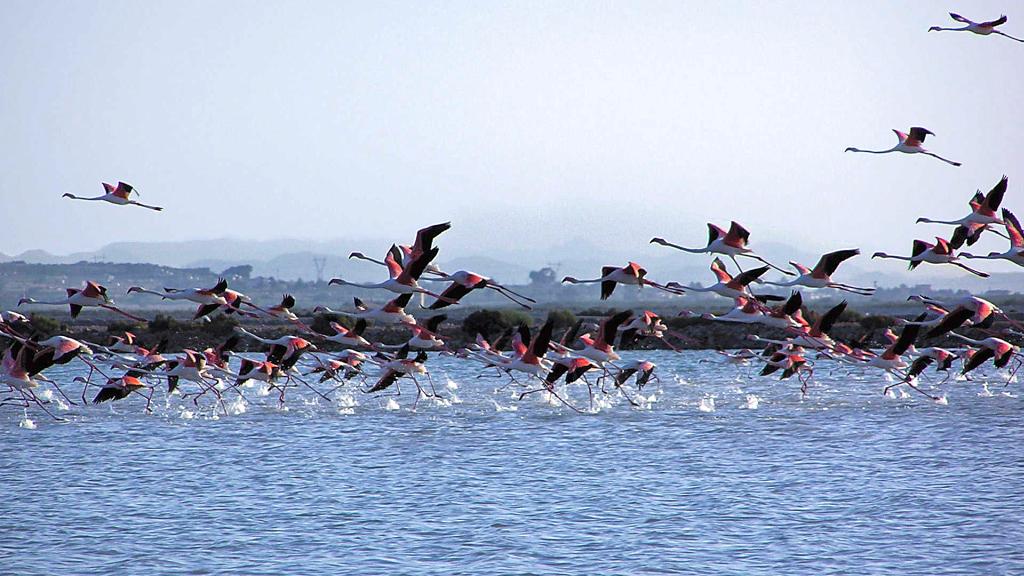
Undoubtedly, one of the star species of the park is the flamingo, which reaches a peak of around 8,000 specimens during the breeding season and there is an overall abundance of birdlife such as avocet, stilt, little tern, shelduck, marbled teal, kentish plover, shoveler, heron, grebe, coot and moorhen. Raptors present in good numbers are marsh harrier, montagu’s harrier and kestrel.
Amphibians and reptiles within the area are Iberian water frog (Rana perezi), Iberian spiny toad (Bufo spinosus), Iberian wall lizard (Podarcis hispanica), Spanish Psammodromus (Psammodromus hispanicus), Spanish sand racer (Psammodromus algirus), Ocellated lizard (Timon lepida), Viperine snake (Natrix maura), Ladder snake (Elaphe scalaris), Montpellier snake (Malpolon monspessulanus) and Horseshoe whip snake (Hemorrhois hippocrepis).
Also noteworthy is the presence of the fartet, an endemic fish from the Spanish Mediterranean region.
Walk of the yellow route: “El Pinet”
3.8 km. Estimated time: 2 h. 15 m. (Not suitable for cycling).
This short walk is highly recommended as it takes you through all of the main habitats and eco systems of salt flats, salt and fresh water lagoons and dunes along with some pine and eucalyptus woodlands.
Information/Visitors Centers
Centro de Visitantes Salinas de Santa Pola Parque Natural
The visitor centre for the Salinas de Santa Pola Natural Park is located in the same building as the salt museum in the town of Santa Pola (Avenida Zaragoza, 45).
Here you will find information about the wildlife of the area and also interesting history regarding salt extraction in the area.
The official website for the Salinas de Santa Pola Natural Park is here: https://parquesnaturales.gva.es/va/web/pn-salines-de-santa-pola
Iberia Nature Forum
Struggling with identifying those bugs and beasties? Why not check out the Iberia nature Forum!
Discover the Iberia Nature Forum – Environment, geography, nature, landscape, climate, culture, history, rural tourism and travel.

Clive Muir – Wildside Holidays – Walking, wildlife and culture holidays in Spain
I’ve been living in western Andalucía for more than 20 years and spend much of my time researching and running English-language travel websites about Spain. My work covers destinations including Cádiz, Ronda, Grazalema and the Caminito del Rey, as well as Wildside Holidays, which focuses on walking, wildlife and nature travel in Spain.
Through Wildside Holidays, I share practical information about Spain’s natural parks, mountains, wildlife and walking destinations, drawing on many years of living and travelling in the country. The aim is to help visitors discover Spain’s natural landscapes responsibly and plan rewarding walking and wildlife experiences.