
The Iberian Highlands is one of Europe’s most ambitious rewilding landscapes, covering more than 850,000 hectares across eastern Spain. Stretching across Castilla-La Mancha and Aragón, this vast area includes the Alto Tajo Natural Park, the Serranía de Cuenca Natural Park and the Montes Universales mountain range.
The landscape is a mixture of extensive pine, oak and juniper forests, open mountain plateaus, river valleys and dramatic limestone gorges. Like many rural parts of inland Spain, it has experienced decades of population decline and the abandonment of traditional agricultural land. This has created both challenges for local communities and opportunities for nature to recover.
The Iberian Highlands rewilding project, led by Rewilding Spain, aims to restore natural processes, encourage the return of native wildlife and help create new economic opportunities through nature-based tourism and sustainable land management.

Video: Breathing New Life into the Iberian Highlands
This five-minute documentary, filmed by award-winning French filmmaker Emmanuel Rondeau of White Fox Pictures, looks at how rewilding is helping to restore nature and create new opportunities for rural communities in eastern Spain.
The film offers a good introduction to the landscape and the work taking place across the Iberian Highlands.
Wildlife tourism opportunities
One of the important aims of the Iberian Highlands rewilding project is to create new opportunities for sustainable tourism and help rural communities benefit from the area’s natural heritage.
The extensive forests, open plateaus and river canyons already provide excellent habitats for wildlife. As conservation work progresses, the region has the potential to attract more visitors interested in birdwatching, wildlife photography, guided nature walks and specialist wildlife holidays.
Vultures and other birds of prey, large mammals and the changing landscape itself offer plenty of interest. Photography hides and guided wildlife experiences could also provide new opportunities for local businesses.
For a region that has experienced decades of rural depopulation, developing responsible nature tourism could become an important part of supporting local communities while giving visitors another reason to explore this fascinating part of Spain.

The Iberian Highlands podcast with James shooter.
This 30-minute podcast offers an insight into the Iberian Highlands rewilding project and the natural heritage of this part of eastern Spain.
The podcast features James Shooter, an experienced and award-winning filmmaker and content creator whose work has appeared on the BBC, Channel 5 and in the Daily Telegraph.
During his visit to the Iberian Highlands, James explored how Rewilding Spain’s work aims to restore natural ecosystems, protect wildlife and help maintain this important landscape for future generations.
You can listen to the podcast here: The Rewild Podcast visits the Iberian Highlands.
Wildlife recovery and reintroduction projects
An important part of the Iberian Highlands project is restoring natural ecological processes and helping native wildlife populations recover. This involves habitat restoration, supporting the return of species that have disappeared from parts of the region, and working with local communities to encourage more wildlife-friendly land management.
The project also promotes practical conservation measures, including the use of lead-free ammunition and efforts to prevent the illegal use of poison, which can cause serious harm to vultures, other wildlife and the wider ecosystem.
Vultures
Cinereous and bearded vultures
The return of large scavenging birds is an important part of the Iberian Highlands rewilding project. Two species receiving particular attention are the cinereous vulture (Aegypius monachus), also known as the black vulture, and the bearded vulture (Gypaetus barbatus).
The cinereous vulture disappeared as a resident breeding species from the Alto Tajo and Serranía de Cuenca around a century ago. A reintroduction programme began in 2020, with birds released after rehabilitation and a period of acclimatisation in specially prepared aviaries. Feeding stations and artificial nesting platforms have also been installed to encourage them to settle.

The programme achieved a major milestone in 2026 when the first cinereous vulture chicks in the area for around a century hatched in the Alto Tajo. This is an encouraging sign that the returning birds may establish a breeding population once again.
Work is also underway to encourage the return of the bearded vulture. Measures include habitat protection, supplementary feeding and efforts to encourage birds to recolonise naturally, alongside preparations for a possible translocation from the Pyrenees.
Video: Bringing vultures back to the Iberian Highlands
This short film, in Spanish, looks at the reintroduction work involving cinereous and bearded vultures in the Alto Tajo and Serranía de Cuenca. It provides a closer look at the conservation efforts helping these important scavenging birds return to the region.
Iberian Lynx
The Iberian lynx (Lynx pardinus) was once on the brink of extinction, largely because of habitat loss, road deaths and a dramatic decline in its main prey, the European rabbit. Following decades of conservation work, captive breeding and reintroduction programmes, the species has made a remarkable recovery.
The latest coordinated census recorded 2,663 Iberian lynx in Spain and Portugal in 2025, almost double the population recorded just four years earlier. Castilla-La Mancha accounted for 1,051 of these animals, although the established populations are concentrated mainly in other parts of the region rather than the Iberian Highlands.
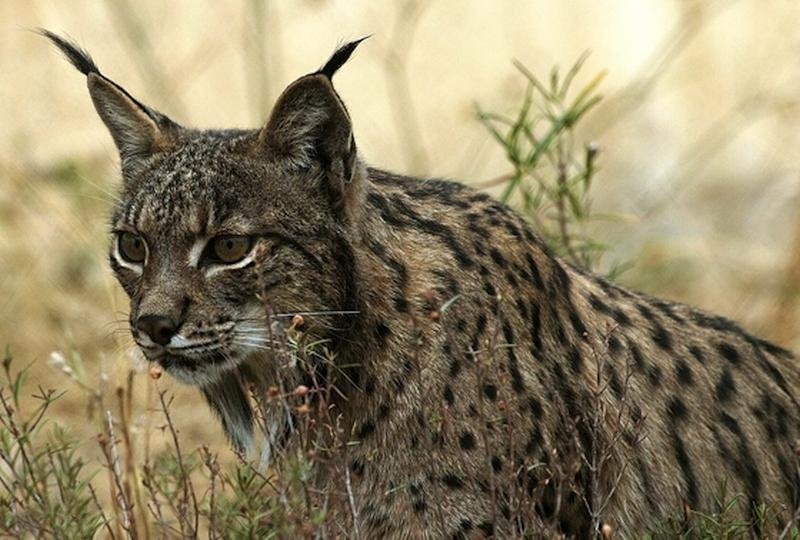
Rewilding Spain has identified the return of the Iberian lynx as an important part of its long-term plans for the area. An experimental release has been proposed, potentially using captive-bred animals that are unsuitable for breeding programmes. However, rabbit populations remain a major consideration, as this small mammal makes up the vast majority of the lynx’s natural diet.
The aim is to establish a viable population that can reproduce and survive independently. If successful, the return of this elusive wild cat would be another significant step in restoring the natural ecosystem of the Iberian Highlands.
The plan is to introduce and maintain a viable and permanent population using lynx that are not suitable for the ongoing breeding programs, captive bred and other relocation projects.
Tauros cattle and the return of the aurochs
The aurochs (Bos primigenius) was a large wild cattle species that once roamed across Europe, including the Iberian Peninsula. It played an important role in shaping natural landscapes through grazing and browsing before becoming extinct in the 17th century.

The Tauros Programme aims to recreate some of the characteristics and ecological role of the aurochs through selective breeding of domestic cattle descended from ancient breeds. The resulting Tauros cattle are not genetically identical to the extinct aurochs, but have been bred to resemble their wild ancestors in appearance and behaviour.
In the Iberian Highlands, Tauros cattle form part of Rewilding Spain’s natural grazing projects. They help maintain open areas within woodland, browse vegetation and create a varied landscape that benefits other plants and wildlife.
Herds have been established at sites including Frías de Albarracín in Teruel and Dehesa de Solanillos near Mazarete in Guadalajara. At the latter site, Tauros graze alongside Serrano horses in an area affected by a major forest fire in 2005. Their presence is part of a wider effort to encourage natural regeneration and improve habitat diversity.

Although the aurochs became extinct in the 17th century, their genes are present in several domestic cattle breeds. By combining this genetic material, the Taurus Foundation created the taurus, which looks and behaves like its wild ancestors. Learn more here: https://rewilding-spain.com/en/news/second-herd-of-tauros-in-the-iberian-highlands-to-strengthen-natural-grazing-in-upper-tagus/
Video: Tauros cattle in the Alto Tajo
This Spanish-language news report looks at the Tauros cattle project in the Alto Tajo, where these animals are helping to restore natural grazing and improve the diversity of woodland habitats.
Natural grazing and woodland regeneration
Following a forest fire in 2005 that affected 11,900 hectares of pine and Pyrenean oak woodland, the burnt trees were removed and the area was left to regenerate naturally. However, the woodland that has since developed is very dense and lacks structural diversity, limiting light penetration and acorn production.
Natural grazing has been introduced to help address this. Horses browse the vegetation and open up the woodland, allowing more light to reach the ground and encouraging a greater variety of habitats. The aim is to create a more diverse landscape that supports long-term natural regeneration. Other areas, including the open high plains around Villanueva de Alcorón, are also being grazed by horses.
Przewalski’s horses
Przewalski’s horses (Equus ferus przewalskii) are considered the last truly wild horses in the world. Originally native to the steppes of Central Asia, they became extinct in the wild during the 20th century and survived through captive breeding and conservation programmes.

They are now playing an interesting role in the rewilding of the Iberian Highlands. The first horses arrived in Villanueva de Alcorón, in Guadalajara province, in 2023. The herd has since grown through new arrivals and successful breeding. By November 2026, 39 horses were living at this site.
Read more here: https://wildsideholidays.co.uk/wild-horses-return-to-the-alto-tajo/
In December 2025, another six Przewalski’s horses arrived at the La Campana estate near Checa, inside the Alto Tajo Natural Park. This was an important milestone, marking the first natural grazing project involving these horses within a protected area of the Iberian Highlands.
Through their grazing and movement, the horses help open up dense vegetation, create a greater variety of habitats and support biodiversity. Their presence is also being studied to understand how large herbivores can contribute to healthier, more resilient landscapes and help reduce the accumulation of combustible vegetation.
The project is also attracting interest from people interested in wildlife and ecotourism, providing another potential opportunity for local communities.
Spanish ibex
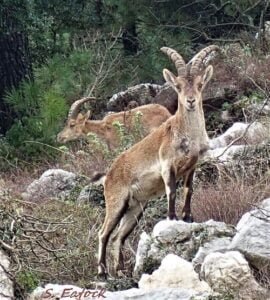
The Spanish ibex (Capra pyrenaica hispanica), also known as the Iberian wild goat or cabra montés, is one of Spain’s most recognisable mountain mammals. It is particularly well adapted to rugged terrain, using steep cliffs, rocky slopes and mountain ledges to escape predators and find shelter.
Males are considerably larger than females and have impressive backward-curving horns, which can grow to a considerable length. They feed on a mixture of grasses, herbs, leaves and shrubs, adapting their diet to the vegetation available throughout the seasons.
The Spanish ibex is already found in several mountain ranges across the Iberian Peninsula, but Rewilding Spain has identified its return to the more rugged parts of the Iberian Highlands as a potential future conservation project.
Reintroducing this native herbivore could help restore the natural grazing and browsing processes that have been lost from parts of the landscape. Its feeding activity would contribute to vegetation management and add another important species to the area’s recovering wildlife populations.
You can find out more about this remarkable mountain animal in our article about the Spanish ibex (Capra pyrenaica).
The wider vision for the Iberian Highlands
“The Iberian Highlands is a vast forest landscape already protected by two large natural parks and many Natura 2000 sites. The area lies in the middle of the so-called ‘Empty Spain’, with very low human population density and depopulation. Rewilding, in combination with other strategies, can make a difference by offering new opportunities that help people to live from the local resources. These resources include a rich and ancient culture, expanses of native pine, juniper and oak forests, impressive cliffs and rocky areas, open arid areas, a diverse guild of wild herbivores, and the source of major rivers, including the Tagus which stretches for over 50km.”
Pablo Schapira
Project Director Iberian Highlands
Where to stay in the Iberian Highlands
The Iberian Highlands covers a huge area, so choosing somewhere to stay depends very much on which part you want to explore. Cuenca city is a convenient base for visiting the western side of the region, while staying in one of the smaller mountain villages gives you a much more rural experience.
Here are two very different accommodation options worth considering.
Parador de Cuenca – a special place to stay
If you fancy making your visit a little more special, the Parador de Cuenca is an excellent choice. Housed in the former Convent of San Pablo, a 16th-century monastery, it occupies a spectacular position above the Hoz del Huécar gorge, directly opposite Cuenca’s famous Hanging Houses.
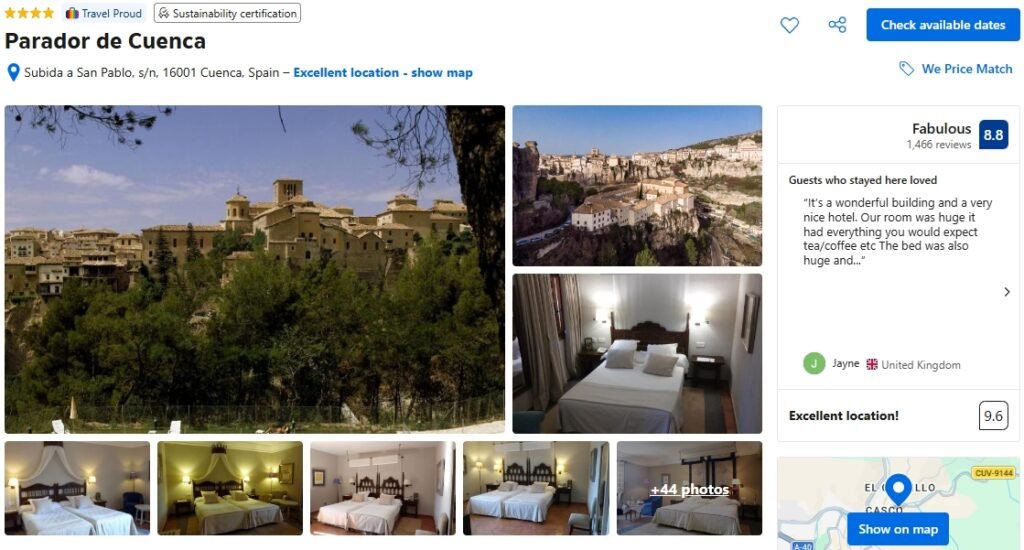
The historic building has been converted into a four-star hotel, retaining features such as its beautiful cloister while incorporating modern comforts. There is a restaurant serving regional cuisine, a café in the former convent chapel and an outdoor swimming pool with wonderful views across the city.
The Parador is particularly well placed for exploring Cuenca’s historic centre and makes a comfortable base for visiting attractions such as the Ciudad Encantada and the surrounding countryside.
Check prices and availability at the Parador de Cuenca on Booking.com.
Casa Rural Papi – rural accommodation in Zafrilla
For something quite different, take a look at Casa Rural Papi in Zafrilla. This welcoming rural guesthouse is situated in the small mountain village of Zafrilla, at around 1,400 metres above sea level.
Casa Papi offers comfortable rooms with private bathrooms, as well as a separate renovated village house for guests wanting more space and independence. There is also an adjoining village bar and restaurant serving tapas, sandwiches and traditional dishes.
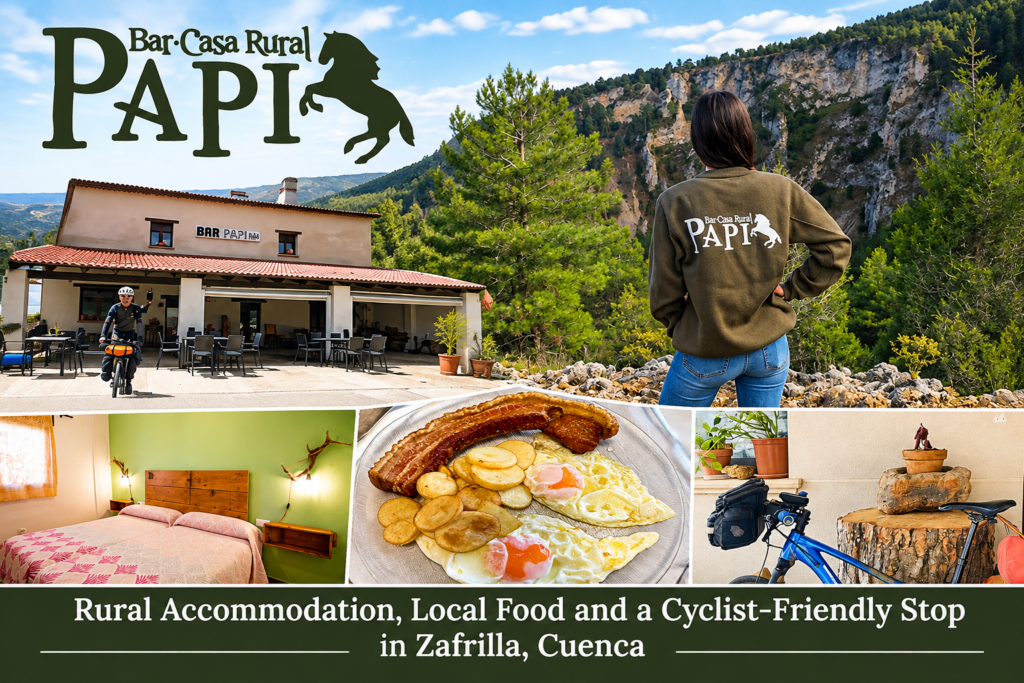
The accommodation is particularly welcoming to walkers and cyclists exploring the surrounding countryside. It is also an official stopping point on the Montañas Vacías cycling route, with useful facilities for people travelling by bicycle.
Zafrilla provides a much quieter mountain experience, with pine forests, open countryside and rural roads to explore. If you want to spend time discovering the eastern Serranía rather than staying in the city, Casa Papi is well worth considering.
Find out more about Casa Rural Papi
How to get to the Iberian Highlands
The Iberian Highlands covers a large area of eastern Spain, so the best route depends on which part you want to visit. The main access points are around Cuenca, Molina de Aragón and Albarracín, with the nearest major towns varying depending on your destination.
By car
Driving is by far the easiest way to explore the Iberian Highlands. The mountain villages and natural areas are spread across a large territory, and public transport between many of them is very limited.
From Madrid, the Alto Tajo area can be reached using the A-2 motorway before continuing towards Molina de Aragón or the surrounding villages. Cuenca is accessible from Madrid via the A-3 and A-40.
From Valencia, the A-3 and A-40 provide access to Cuenca and the southern part of the region. For the eastern areas around Albarracín and the Montes Universales, Teruel is a useful starting point.
Allow plenty of time for driving once you leave the main roads. Many routes follow narrow mountain roads through forests and small villages, and distances can be deceptive.
By train and bus
Cuenca is one of the easiest starting points for visitors travelling without a car, with high-speed rail connections to Madrid and Valencia. Molina de Aragón and Albarracín can also be reached by bus, although services are less frequent.
However, public transport within the Iberian Highlands is very limited. Reaching the smaller villages, natural attractions and wildlife observation areas can be difficult without your own transport.
Visiting the rewilding areas
If your main interest is seeing the wildlife recovery projects, Rewilding Spain works with specialist local ecotourism companies that organise guided visits to selected sites. These include areas with Przewalski’s horses, Tauros cattle and European bison.
You can find details of the locations, local operators and available experiences on the official Rewilding Spain visitor information page.
Further reading and useful links
Official rewilding project
Explore the natural parks
Recent developments and conservation news
- The first European bison calf born in the Iberian Highlands
- Cinereous vultures breed in the Alto Tajo for the first time in a century
- Reto Ibérico – a new 500 km walking route through the Iberian Highlands
Frequently asked questions about the Iberian Highlands Rewilding Project
The Iberian Highlands Rewilding Project is a large-scale nature restoration initiative led by Rewilding Spain. It covers more than 850,000 hectares across eastern Spain, aiming to restore natural ecosystems, encourage the recovery of native wildlife and create new opportunities for rural communities through nature-based tourism and sustainable land management.
The Iberian Highlands are located in eastern Spain, across the autonomous communities of Castilla-La Mancha and Aragón. The project includes the Alto Tajo Natural Park, Serranía de Cuenca Natural Park and Montes Universales mountain range, an extensive landscape of pine forests, juniper woodland, mountain plateaus and river gorges.
Several wildlife recovery and natural grazing projects are taking place across the Iberian Highlands. These include the reintroduction of cinereous vultures, the use of Tauros cattle and Przewalski’s horses to restore natural grazing, and plans to encourage the return of species such as the Iberian lynx and Spanish ibex.
Yes. The region supports populations of red deer, roe deer, wild boar, mouflon, Spanish ibex and numerous birds of prey, including griffon and Egyptian vultures. Conservation projects are also helping species such as the cinereous vulture recover. Wildlife sightings are never guaranteed, but the forests, cliffs, river valleys and open mountain landscapes offer excellent opportunities for nature observation and photography.
Yes. The Iberian Highlands is an extensive rural region with natural parks, villages, walking routes and opportunities for nature-based tourism. Visitors can explore areas such as the Alto Tajo and Serranía de Cuenca, discover the local wildlife and enjoy the landscape. The Reto Ibérico, a long-distance walking route linking villages and natural areas, is another developing opportunity to explore this part of Spain.

Clive Muir – Wildside Holidays – Walking, wildlife and culture holidays in Spain
I’ve been living in western Andalucía for more than 20 years and spend much of my time researching and running English-language travel websites about Spain. My work covers destinations including Cádiz, Ronda, Grazalema and the Caminito del Rey, as well as Wildside Holidays, which focuses on walking, wildlife and nature travel in Spain.
Through Wildside Holidays, I share practical information about Spain’s natural parks, mountains, wildlife and walking destinations, drawing on many years of living and travelling in the country. The aim is to help visitors discover Spain’s natural landscapes responsibly and plan rewarding walking and wildlife experiences.
2 thoughts on “The Iberian highlands rewilding project”
Comments are closed.